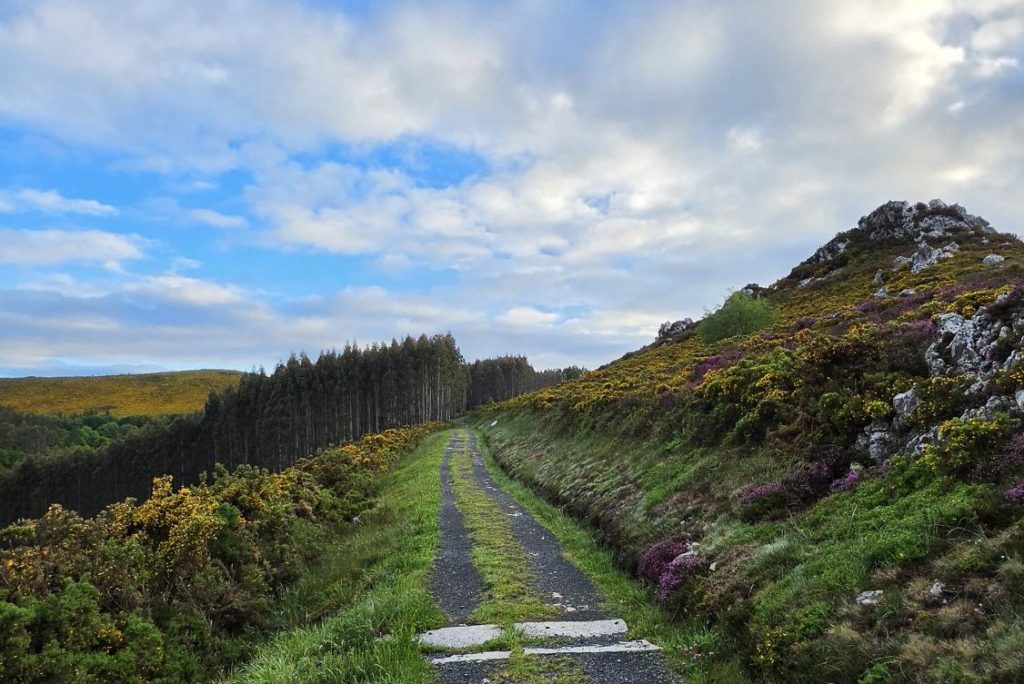
Days 8-10: A Fonsagrada → O Cádavo → Lugo → Ferreira
[New here? Start the Camino with Part One ->]
[Already following along? Catch up on Part Two ->]
By this point on the Camino Primitivo, the mountains were beginning to fall behind me and Santiago was starting to feel less like a distant destination and more like somewhere I might actually reach.
The next stretch would take me from A Fonsagrada to Lugo and onwards towards Ferreira, carrying me past the final 100-kilometre marker and into a very different chapter of the Camino.
The dramatic climbs of Asturias had given way to long days through the Galician countryside, but the Camino certainly wasn’t finished testing me yet. There was more rain, more kilometres, a backpack that was still far too heavy, and increasingly the familiar faces that had somehow become part of my everyday life.
By now, the people I had met along the way weren’t simply pilgrims I happened to recognise. They were the people I looked for at cafés, expected to find at the next albergue, and somehow always ended up sharing a drink with at the end of the day.
And somewhere amongst all of that, the numbers were getting smaller.
200 kilometres walked.
100 kilometres to Santiago.
The end was getting closer.
But first, there was still quite a bit of walking to do.
Day 8 — A Fonsagrada to O Cádavo
Distance: 25.33 km
Moving time: 5:15:53
Elevation gain: 726 m
Steps: 23,236
So far, I had been remarkably lucky with the rain.
Considering I was walking the Camino Primitivo through northern Spain in May, I’d been caught in it surprisingly few times. There had been showers, of course, and Hospitales had given us its fair share of questionable weather, but I hadn’t yet experienced one of those days where the rain simply starts… and doesn’t stop.
Day Eight was about to change that.
I left A Fonsagrada at around 7am, as usual, and the morning was absolutely beautiful.
The sky had that gorgeous mixture of colours that always makes me think bad weather is coming. I don’t actually know whether there is any meteorological truth behind that whatsoever, but I remember looking at it and thinking how beautiful it was.
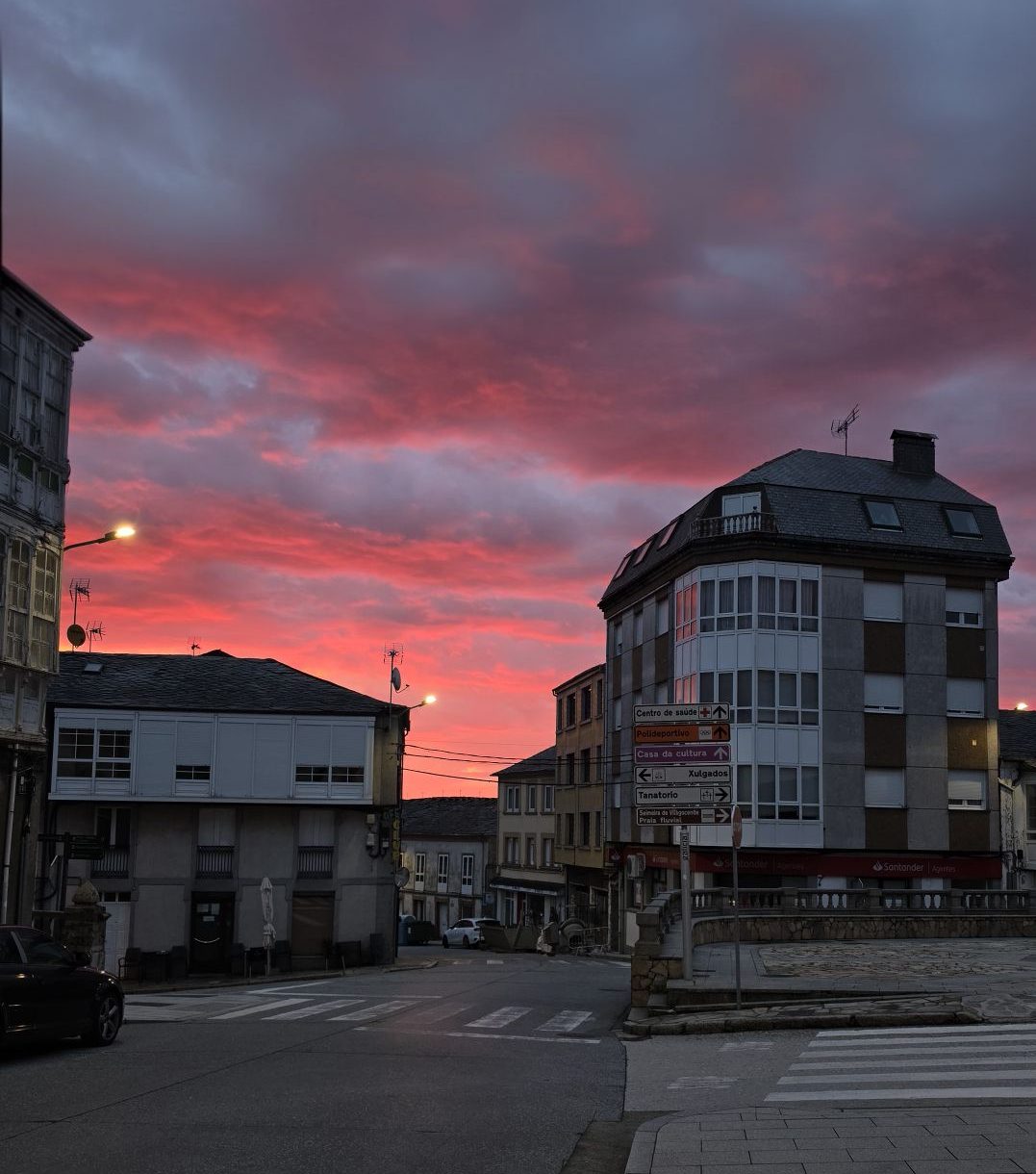
I knew rain was forecast. I’d checked.
But it wasn’t supposed to arrive just yet.
Famous last words.
Before properly setting off, I stopped at a little café where several other pilgrims were already having breakfast, backpacks propped up around them. I ordered the Camino essentials – café con leche, orange juice and something quick to eat – before heading out towards O Cádavo.
My backpack was, once again, packed to the absolute brim.
I’d made myself a baguette for lunch, had extra food, yoghurt, all my water and everything else I apparently considered necessary for survival. The backpack was already too heavy before adding food and water, so by the time I put it on that morning, it felt ridiculous.
But by Day Eight I’d become quite accustomed to carrying my portable house around Spain, so off I went.
For quite a while, there was hardly anybody ahead of me. The only people I kept seeing were two Spanish guys walking together, one of whom I think was from Seville.
We didn’t have much of a shared language. They didn’t speak much English and my Spanish certainly wasn’t going to sustain a meaningful conversation.
Later, however, we would discover that misery is actually a universal language.
Into the Rain
For the first hour or so, everything was lovely.
The route took me through countryside and forest, across rolling hills that weren’t exactly mountains but certainly felt substantial with a heavy backpack strapped to me. At one point I reached the top of a hill and looked out ahead.
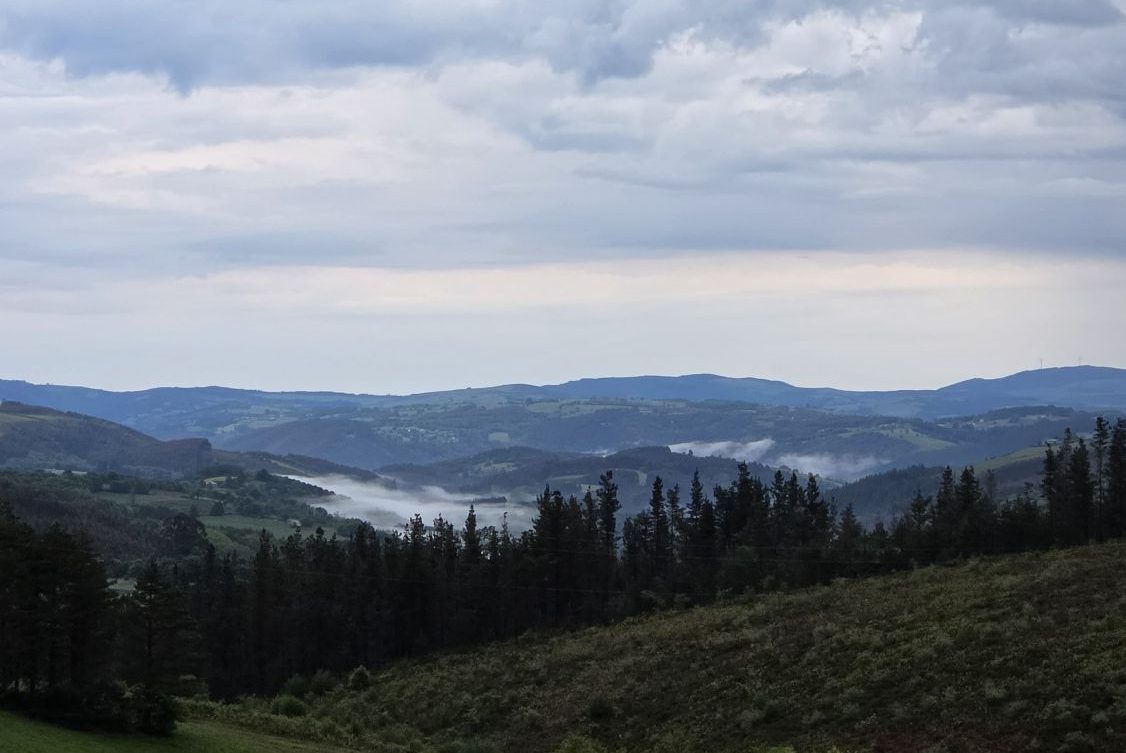
The sky had changed.
You could almost see the weather moving towards us.
Oh. That looks like rain.
For a brief moment, I genuinely thought perhaps I’d manage to get down the hill before it reached me.
Reader, I did not.
The heavens opened.
Thankfully, for once in my life, I had actually prepared. Because I knew rain was forecast, my backpack cover was already on and I’d kept my poncho somewhere easily accessible.
I ducked underneath some trees, pulled the poncho over myself and then put my backpack back on over the top.
At the time, this seemed perfectly logical.
It was not.
Once I’d fastened all the backpack straps and clips again, I realised that my little bum bag, containing my phone and everything I normally wanted quick access to, was now completely trapped underneath my poncho and backpack.
And it was raining far too heavily to start dismantling the entire operation.
So that was that.
No phone.
No casually checking the route.
No taking photographs.
Just walk.
And when I say it rained, it rained.
The paths became muddy and slippery. The route kept rolling up and down through the forest, and some of the descents were steep enough that I became very conscious of every single step.
This was where my walking poles earned their place in my backpack.
Coming downhill through mud and running water with that much weight on my back was genuinely sketchy. I was moving much more slowly than usual because I was terrified of slipping.
I remember thinking very clearly: If I fall over here, I’m not getting back up.
I could already picture myself lying on my back like an overturned turtle, somewhere in a Spanish forest, being absolutely battered by rain while I waited for another pilgrim to eventually appear and haul me upright.
So I took my time.
The two Spanish guys and I developed our own strange little rhythm throughout the day. They were much faster than me uphill and would disappear ahead. Then we’d reach flatter ground, Road Runner would reappear, and I’d catch them again.
Then another hill.
Off they’d go.
Then I’d catch them.
Nobody needed to say anything. Every time we passed one another, soaked underneath our ponchos, we could see the pain in each other’s faces.
Road Runner was not having a good day.
A Very Welcome Café
Eventually, somewhere in the middle of all this rain, I came across what felt like an oasis.
A tiny café.
I don’t think I’ve ever been so happy to see one.
Inside were other dripping pilgrims, with wet ponchos hanging from the beams. There were several faces I’d seen repeatedly along the Camino, including the two Ukrainian women I’d crossed paths with before.
I peeled off my poncho, went to the loo and sat down with a hot café con leche, some orange juice and a slice of Tarta de Santiago.
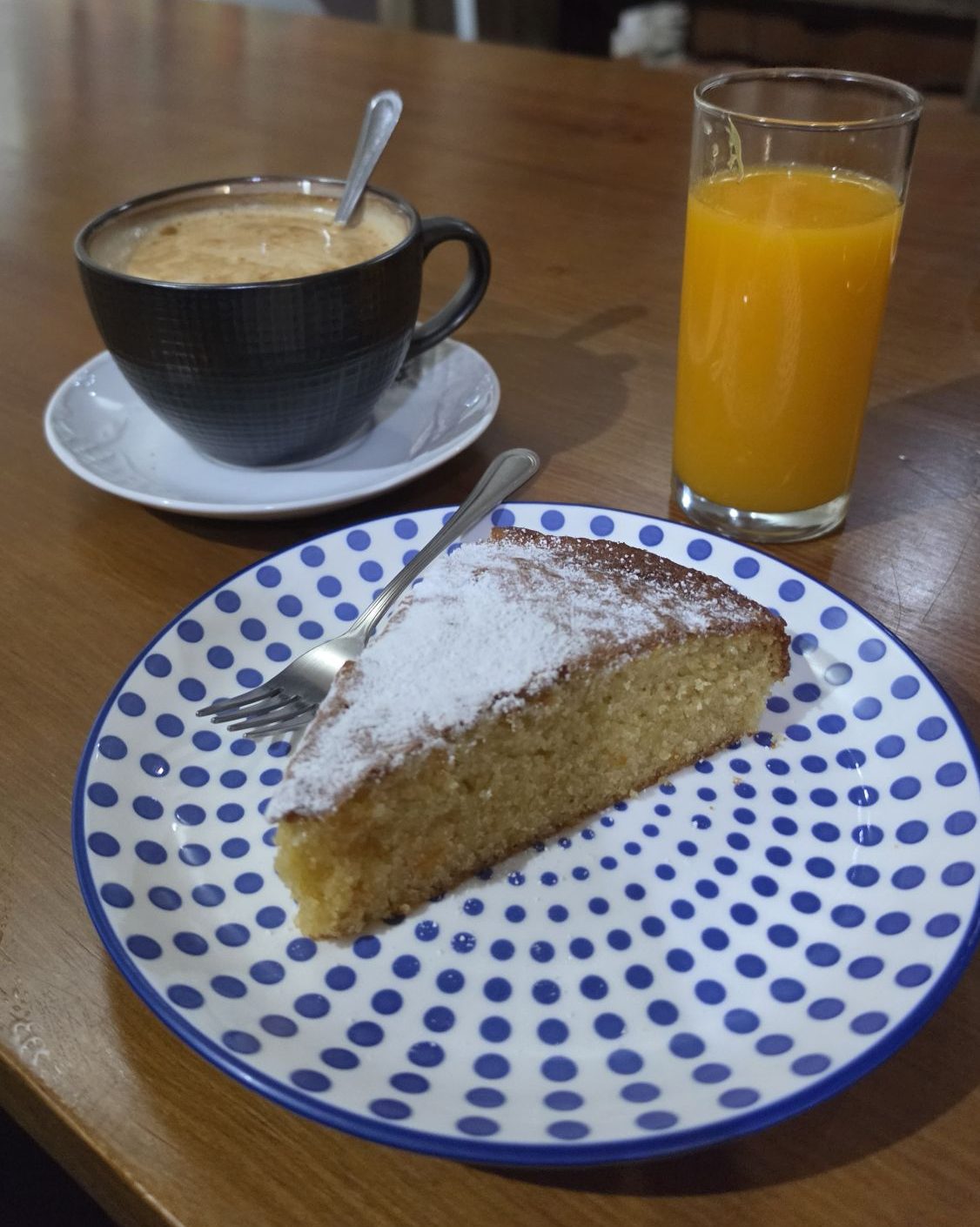
For a little while, I was warm.
I was dry-ish.
There was coffee.
There was cake.
Life was improving.
Unfortunately, the Camino was still waiting outside.
Eventually the poncho went back on, the backpack went back on, and out into the rain I went again.
The rest of the walk continued in much the same fashion: rain, mud, hills, careful descents and an increasingly impressive amount of water inside my trainers.
I’d been wearing my dark backup pair because my other trainers still hadn’t properly recovered from the soaking they’d received around Hospitales.
Now Pair Number Two was joining them.
Excellent.
By the final stretch, I’d stopped trying to keep pace with anyone.
The two Spanish guys were well ahead of me by then and I was quite happy to let them be. After spending hours concentrating on every slippery descent, I was taking my time.
And then, finally, the rain stopped.
The sky began to clear and, almost immediately, it started feeling warm underneath my poncho. After hours wrapped inside it – with my backpack strapped over the top and virtually no air circulating underneath – I couldn’t wait to get the thing off.
So I stopped, peeled myself out of it and opened up the top of my backpack.
I couldn’t even be bothered to fold or roll the poncho away properly. Instead, I draped the wet thing across either side of my backpack and carried on walking, hoping it might dry a little as I went.
And then I reached the top of what felt like one final, enormous hill.
The Final Descent
Down below, in the distance, I could see O Cádavo.
After hours of rain and forest and mud, there it was.
The end of the day.
I have photographs from that final descent, and looking at them now you’d almost never know what the previous few hours had been like. The rain had gone, the landscape had opened up and somewhere down there was a shower, dry clothes and, hopefully, somewhere to take this ridiculous backpack off my shoulders.
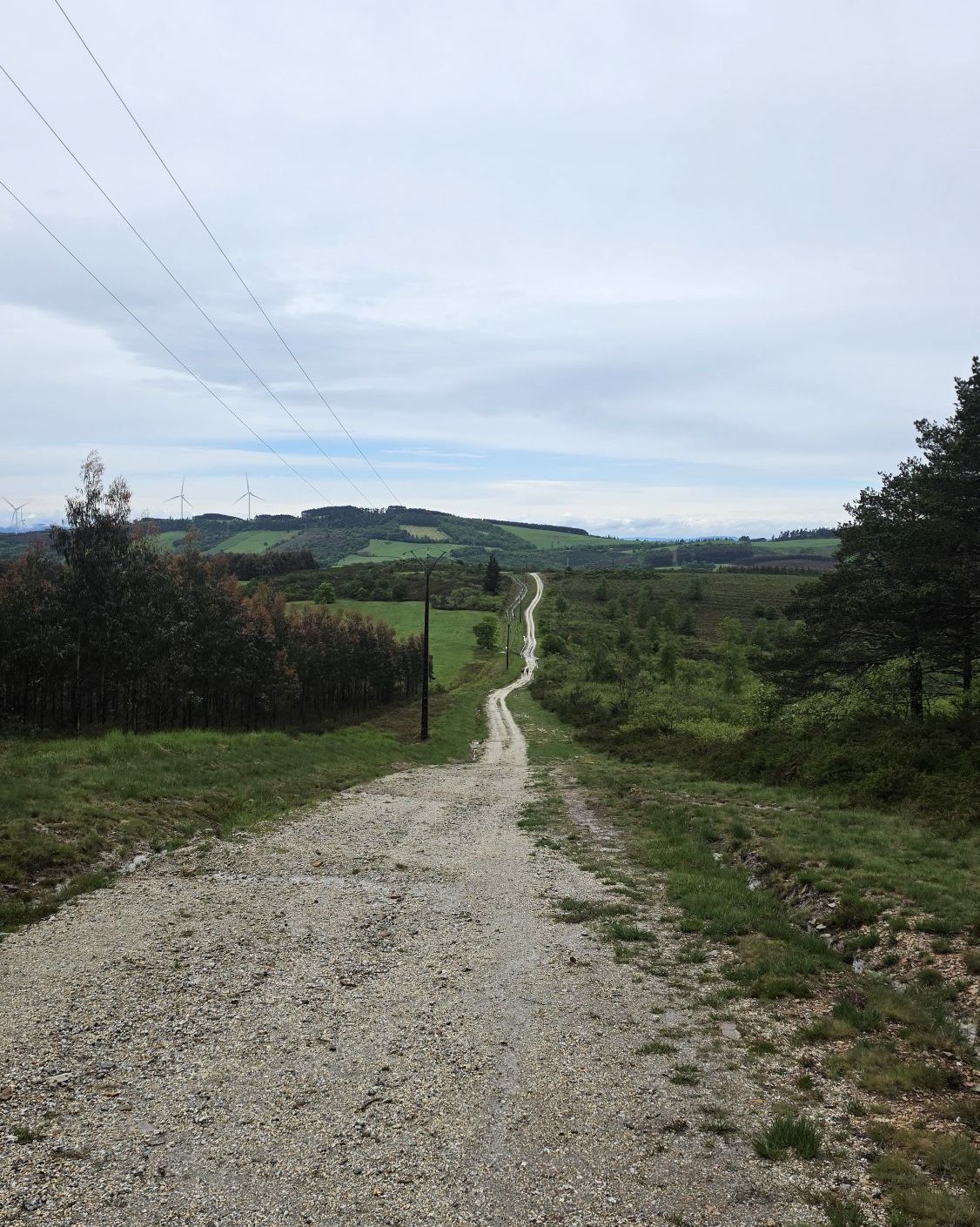
So I started walking down.
I also barely saw anybody I properly knew for most of the day, which had made me wonder whether I’d somehow fallen miles behind everyone.
I felt slow.
Everything hurt more with the weight of the backpack.
The terrain had slowed me down.
Surely everybody else must already be there?
Apparently not.
When I finally reached O Cádavo, the albergue wasn’t even open yet.
One other pilgrim, a man I’d seen a couple of times along the route, had arrived only shortly before me and was also waiting.
I’d somehow done it again.
Despite spending most of the day convinced I was crawling through the forest at the speed of a pensioner, I was the first of my usual Camino crowd to arrive.
Road Runner reputation: intact.
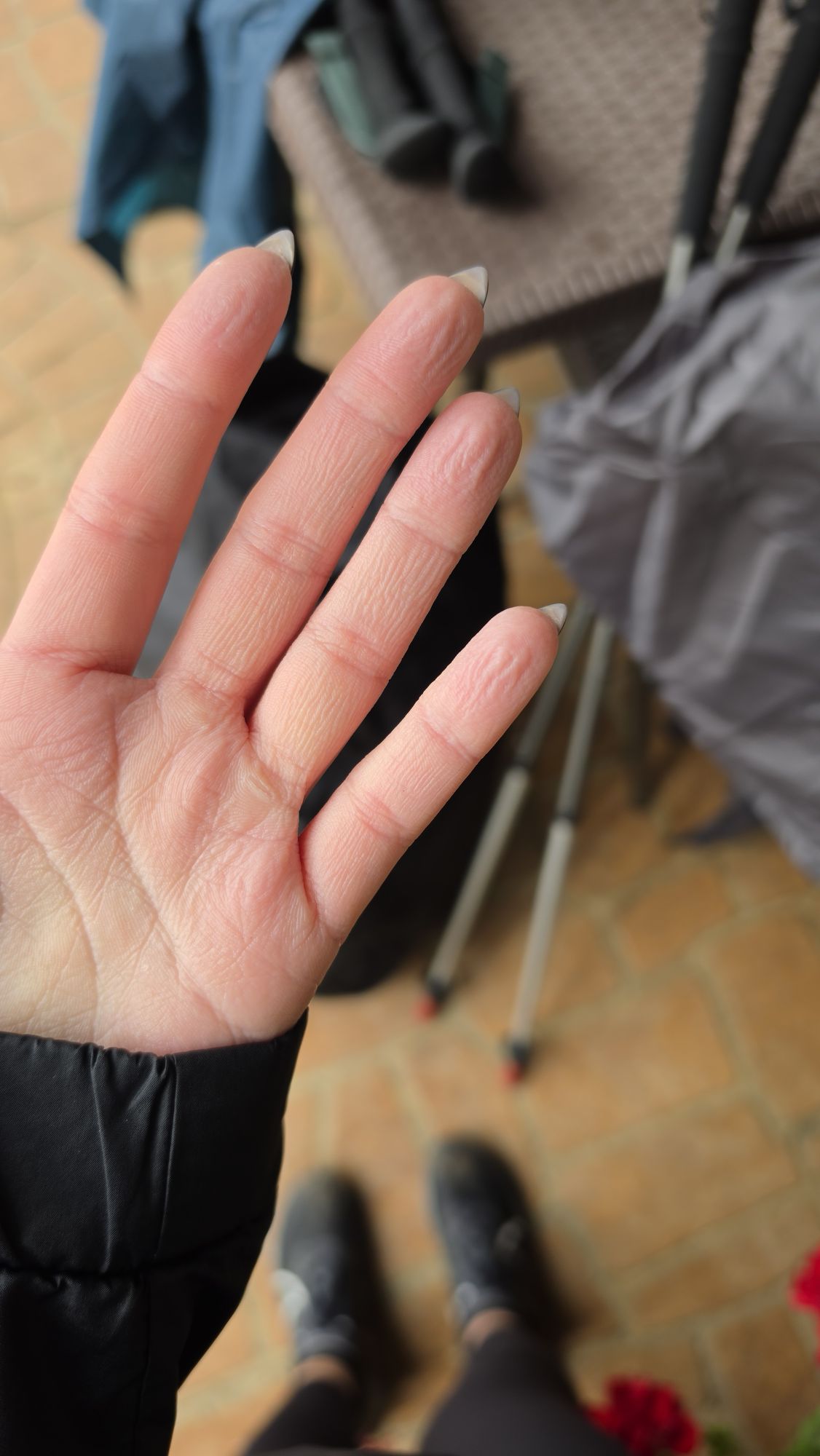
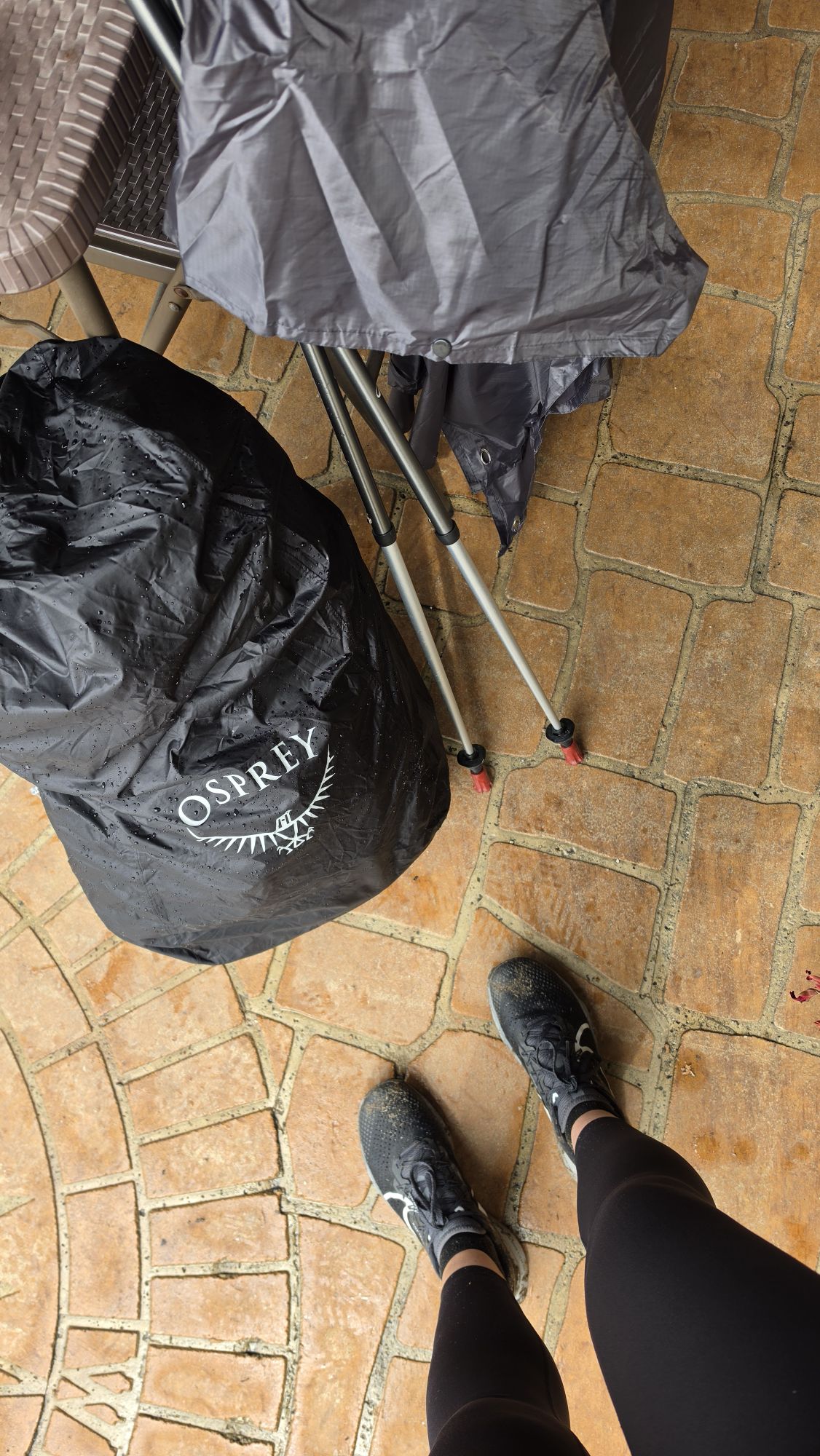
While I waited outside for the albergue to open, I looked down on my hands and realised just how long I’d been walking in the rain. My fingers were completely pruned after hours of being soaked. The kind you normally get after spending far too long in the bath.
Naturally I took a photo. If there was ever proof of how wet that morning had been, this was probably it.
When the albergue eventually opened, I discovered what may genuinely have been one of the greatest inventions on the entire Camino.
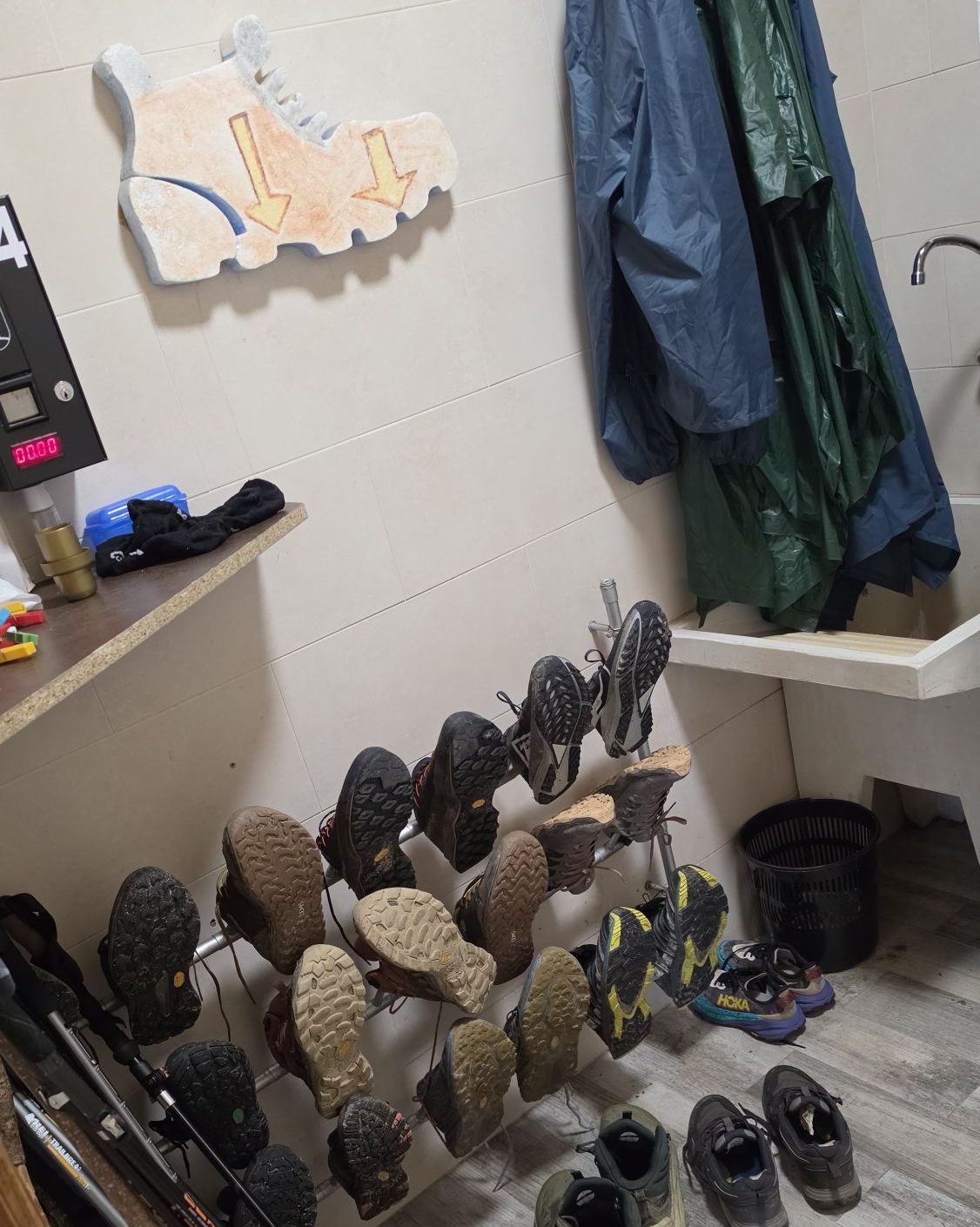
Heated shoe dryers.
Little warm radiator-like stands specifically designed for you to slide your soaking wet shoes onto.
I stared at them like I’d discovered electricity.
After days of trying to dry wet trainers in albergues with varying degrees of success, somebody had finally understood exactly what pilgrims needed.
My completely drenched trainers went straight onto one.
There was also a laundry service where you could leave your clothes and have everything washed, dried, folded and returned to you later, although I didn’t actually need to use it that day.
I showered, changed into dry clothes and began watching the other pilgrims gradually arrive.
Eventually, familiar faces started appearing.
Then came the Texas crew.
It was genuinely lovely seeing them walk in after spending most of the day alone. We caught up, compared our respective levels of suffering and, inevitably, started discussing our various aches and pains.
By this point, something in my leg had also started bothering me enough that I wanted to find a pharmacy and get some sort of gel or cream for it.
A Lighter Load
More importantly, I was beginning to accept something I had stubbornly avoided for the first eight days: my backpack was too heavy.
I had carried it the entire way so far, but between the weight, the hills and whatever was beginning to complain in my leg, continuing to prove that I could carry everything didn’t necessarily mean that I should.
Patrick from the Texas crew was having some issues too, and he was considering sending his backpack ahead the following morning.
So we started looking into the baggage transfer service.
I’d used baggage transfer extensively on my Camino Portugués after discovering, rather quickly, that I’d packed far too much. This time I’d deliberately wanted to carry my own backpack.
And technically, I’d made it eight days.
I decided that was enough proving of points.
Patrick and I worked out the system, where the bags needed to be left and how we needed to arrange the collection for the following morning.
Tomorrow, Road Runner was travelling lighter.
But first: dinner.
A group of us found a restaurant serving a pilgrim-style menu and sat down together for a proper meal. The Texas crew were there, Paulina joined us, and another woman I’d crossed paths with along the route ended up joining our table too.
It was the first time I’d properly sat down for dinner with the Texas crew.
After such a relentlessly wet, lonely day, there was something particularly lovely about ending it around a table with familiar Camino faces, eating a three-course meal and drinking a little wine.
Then it was back to the albergue and another early night.
We had a long stage ahead of us the following morning, and everybody wanted an early start.
Before bed, I checked on my trainers.
Still on their magical little heaters.
And when I put them on the following morning?
Dry.
Warm.
Slightly toasty.
Absolute luxury.
Day Eight had started beneath one of the prettiest skies I’d seen on the Camino and descended into the wettest day I’d experienced so far.
But I’d made it.
I hadn’t fallen.
I hadn’t needed rescuing from the forest like an overturned turtle.
And somehow, despite everything, Road Runner had still been one of the first through the door.
Another one done.
Day 9 — O Cádavo to Lugo
Distance: 31.02 km
Moving time: 5:44:54
Elevation gain: 512 m
Steps: 37,044
There was no breakfast waiting for me in O Cádavo that morning.
Thankfully, somewhere amongst my things I still had a collection of vaguely breakfast-appropriate snacks that I’d bought a few days earlier and had subsequently been carrying around with me. After getting a free four-day tour of northern Spain, they finally served their purpose.
It wasn’t exactly breakfast, but it would have to do.
I had a long day ahead of me.
The night before, I’d also finally done something about the weight of my backpack.
Not quite enough, as it turned out.
I had a tote bag with me that I’d used on my previous Camino, so I repacked some of my things into that, attached the luggage transfer tag and left it behind at the albergue to be collected and transported ahead to Lugo. Patrick was sending some of his luggage ahead too.
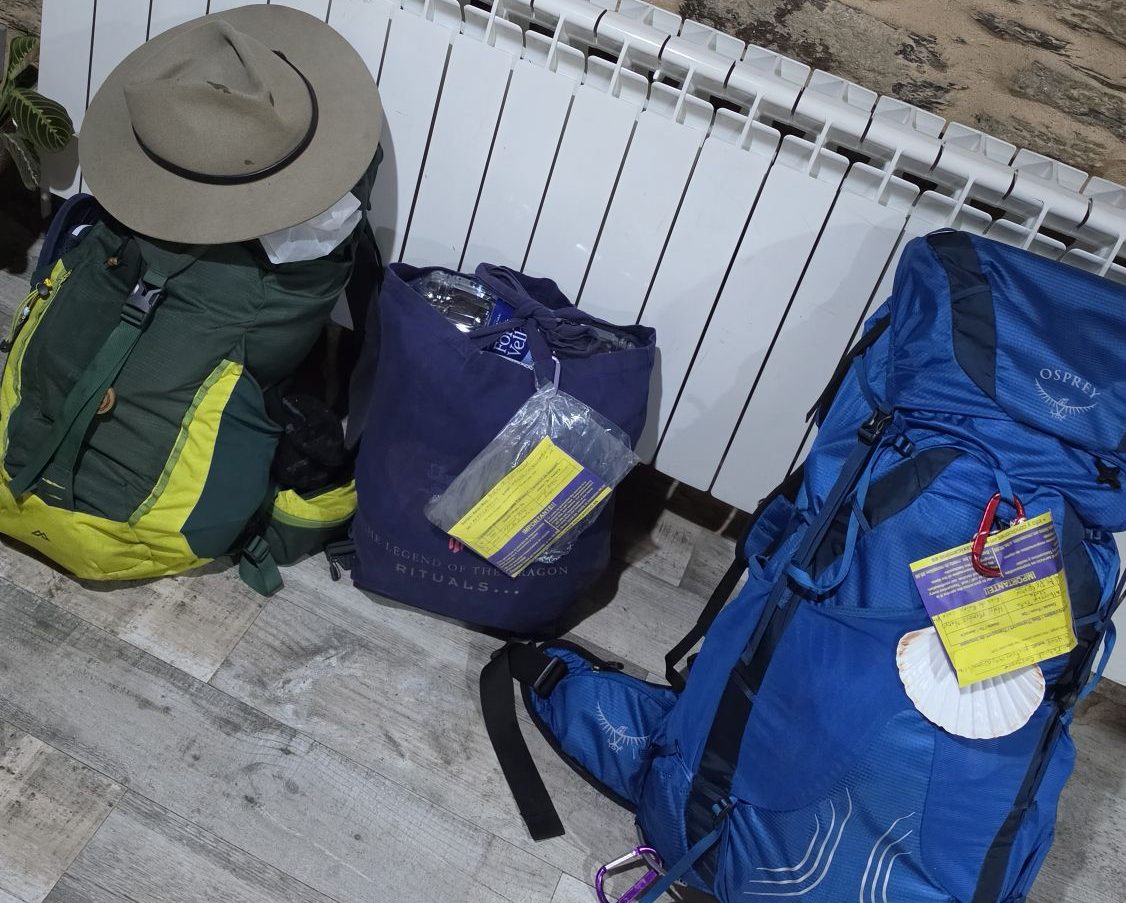
My actual backpack, however, was still very much coming with me.
Before we left, some of the Texas crew picked it up, now supposedly in its lighter form, and their reaction was essentially: “Oh my God.”
Which was reassuring.
Yes, I had taken some of the weight out.
Technically.
But judging by everybody else’s reaction when they picked it up, my backpack was still far heavier than any sensible person’s Camino backpack had any business being.
Still, when I put it back on that morning, I could feel the difference.
It was lighter.
Not light.
But lighter.
At this point, I was taking the win.
Especially because I had just over 31 kilometres ahead of me, my longest hike recorded on Strava at that point, and my destination was Lugo.
Lugo was significant for another reason too.
It marked roughly 100 kilometres to Santiago.
That number means something on the Camino. For many pilgrims, Lugo is where their journey begins, allowing them to walk the final stretch towards Santiago and complete the required distance for their Compostela.
For me, reaching that marker would mean something slightly different.
By then, I had already walked around 200 kilometres. I had essentially already covered the distance of my entire Camino Portugués.
And I still had another hundred to go.
Into the Dark
I left O Cádavo at 6:32 a.m., while it was still dark.
The German pilgrim who had arrived at the albergue shortly before me the previous evening had already left. Later, every now and then, I could make him out somewhere ahead of me, but otherwise I seemed to have the Camino almost entirely to myself.
For the first few minutes, I thought I might actually get lucky with the weather.
Naturally, the Camino had other ideas.
Not even ten minutes into the walk, the rain started again.
By this point, putting waterproofs on and taking them back off had practically become part of my morning routine. The rain continued on and off for a while, around the first 45 minutes or so, before eventually beginning to clear.
And once it did, the day completely changed.
The clouds began to lift, the countryside opened up around me and, eventually, the sunshine even made an appearance.
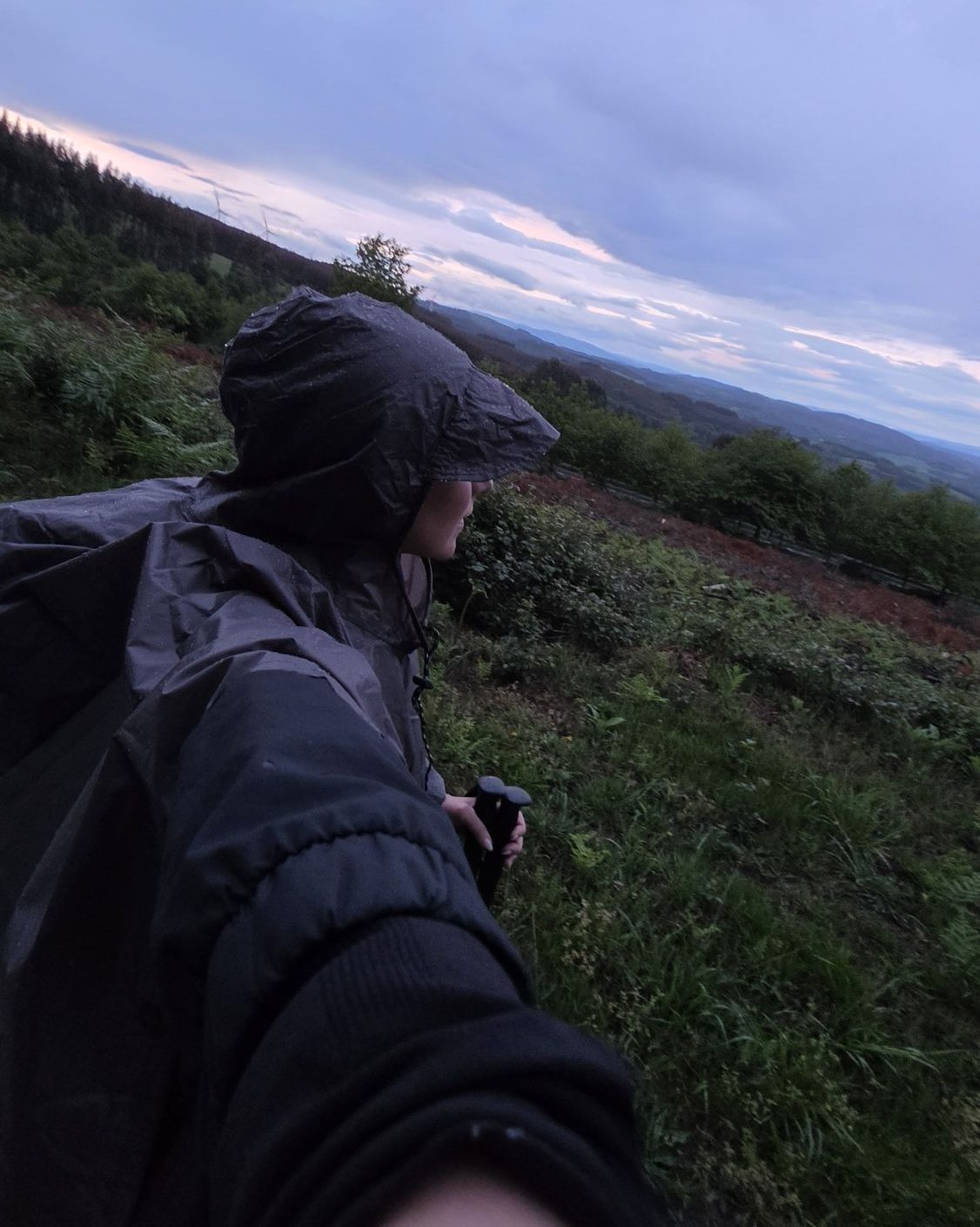
Somewhere amongst all of this, I attempted to take a photo or video of myself walking through the countryside.
Hood up. Walking poles in both hands.
I looked like Gandalf the Grey.
There is really no other way of describing it.
Apparently, instead of walking to Lugo, I was making my way through Middle-earth.
I have photographic evidence.
The Long Road to Coffee
Terrain-wise, this actually wasn’t one of the particularly difficult days of the Primitivo. There were rolling hills, stretches of countryside and plenty of relatively easy walking.
The challenge was simply the distance.
It just kept going.
And because I had left so early, it was incredibly quiet.
I walked through little villages and passed places where I kept thinking:
Surely I’ll be able to get a coffee here.
Nope.
Closed.
So I kept walking.
Fine. The next village.
Also closed.
I had left with my makeshift snack-breakfast and somehow managed to spend kilometre after kilometre failing to find anywhere that was actually open.
All I wanted was a proper coffee.
Apparently, that was too much to ask.
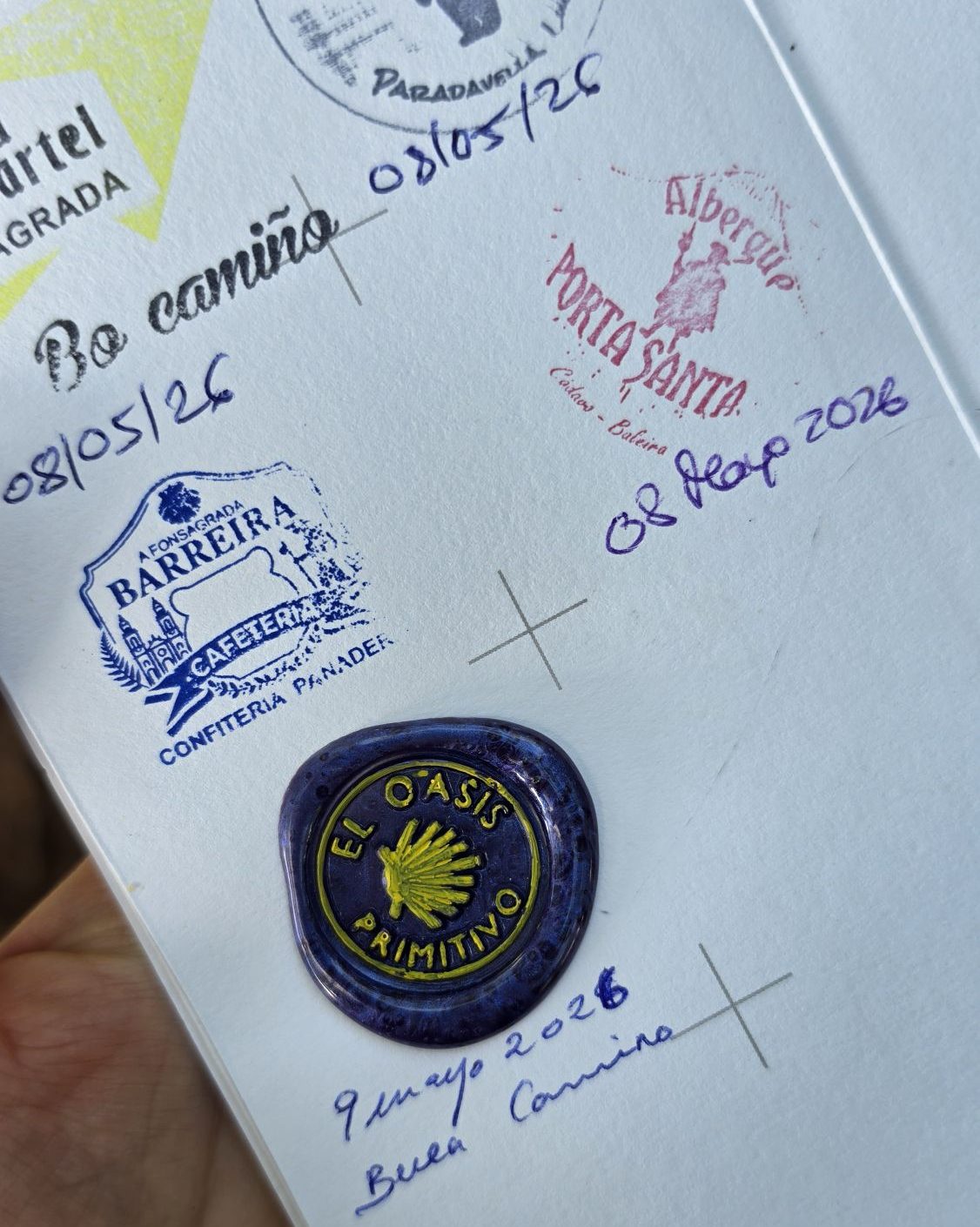
What I did find, tucked away along the route in the woods, was one of those wonderful little pilgrim stops that seem to appear from nowhere.
It reminded me a little of the self-service place I’d found earlier on the Camino, leaving Salas, except this one had something particularly special.
They were stamping pilgrim credentials using actual wax seals.
Everything worked on a donation basis, so naturally I stopped and added one to my credential.
There are plenty of stamps in there that tell me where I was on a particular day.
And then there are the ones that bring the whole moment back.
That wax stamp is definitely one of them.
Then it was back onto the trail.
More countryside. More tiny villages. Horses along the way. At one point, I even spotted a stork.
And mostly?
Just me.
It was strange because by then the Camino had become such a social experience. Even on the days when I chose to walk alone, there was usually somebody appearing eventually – somebody to catch up with, somebody overtaking me, or a familiar backpack disappearing somewhere ahead.
That morning, there was almost nobody.
Just long stretches of countryside, my walking poles, my still-too-heavy backpack and a lot of time inside my own head.
Eventually, the kilometres began to make themselves known.
Lugo wasn’t going to let me arrive completely effortlessly either. Towards the end there was another little climb, including a set of steps that seemed particularly unnecessary after thirty-odd kilometres.
But I climbed them.
And eventually, I made it.
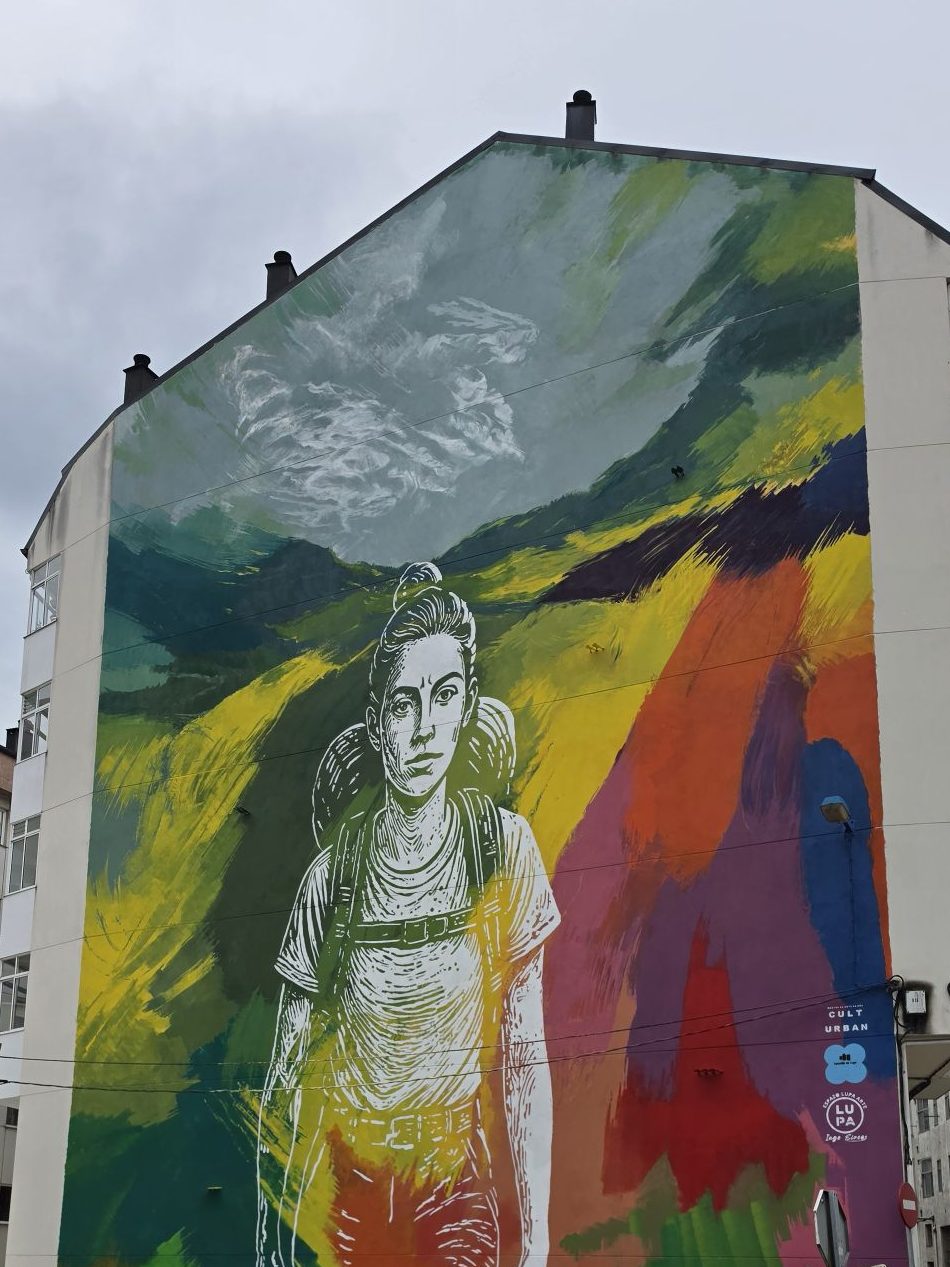
100 Kilometres to Go
There it was.
Lugo.
And the sign I’d been waiting for: 100 kilometres to Santiago.
Obviously, there were going to be photos.
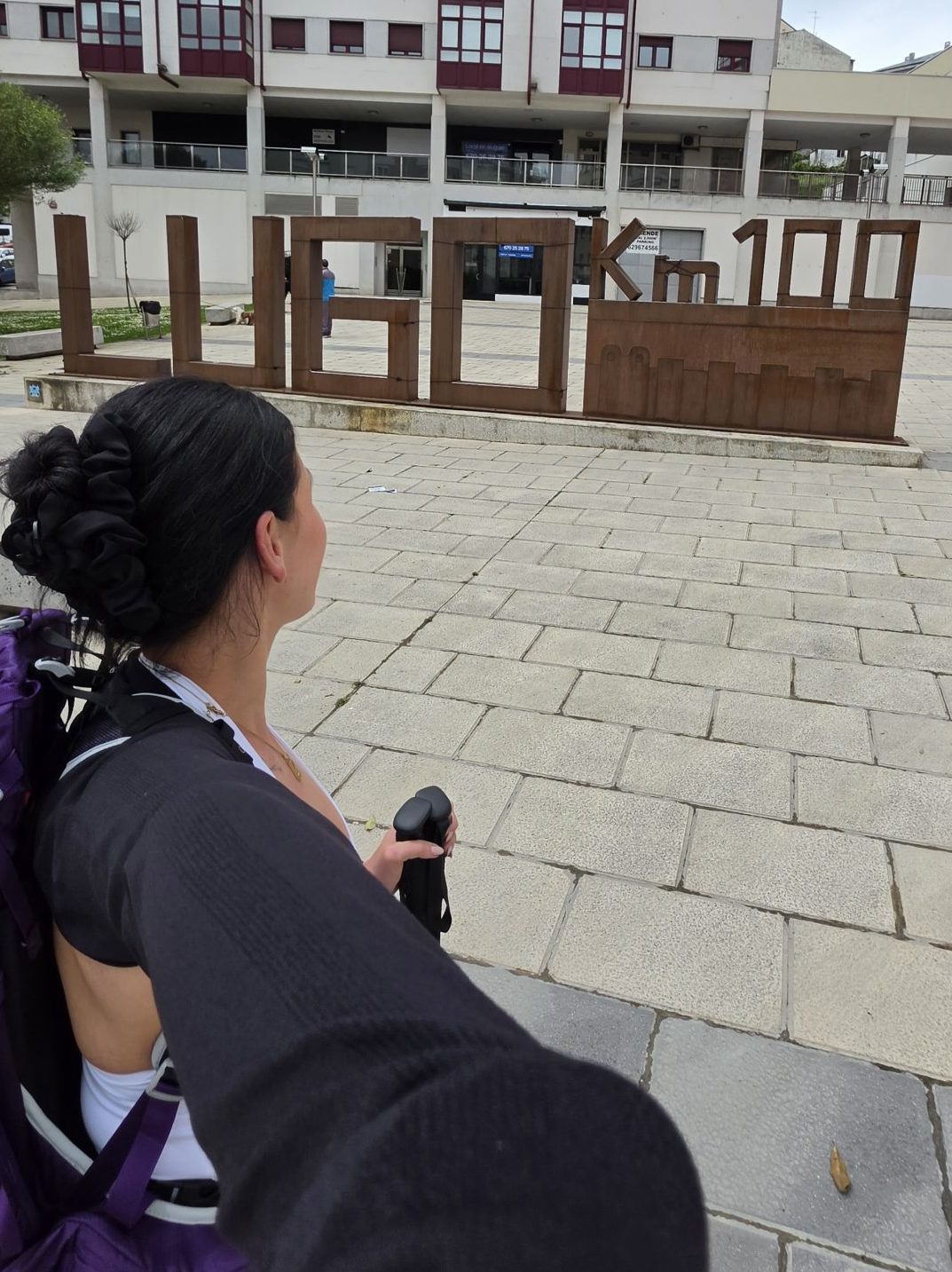
After everything I had already walked through to get there – Hospitales, the rain, the mountains, the ridiculous backpack, the aching shoulders and kilometre after kilometre of northern Spain – seeing that number felt significant.
Only 100 kilometres left.
Which is a slightly ridiculous sentence when you stop and think about it, because 100 kilometres is still quite a long way to walk.
But by Camino standards?
I was getting close.
There was, however, a slightly more immediate priority.
Coffee.
I spotted a café not far from the Lugo sign and essentially parked myself outside.
Finally.
I ordered something resembling a proper breakfast, I think it was some sort of yoghurt bowl, along with coffee and juice.
At that point, I was absolutely dead.
And while I was sitting there outside, finally waiting for the coffee I had been thinking about for practically the entire walk, I looked across towards the Lugo sign.
Familiar faces.
The Three Musketeers. And Martin.
I immediately started waving at them like a lunatic from across the road.
After spending the entire morning barely seeing another person, suddenly there they were.
They’d actually already walked past the café, but the woman working there had told them that they did really good tapas and that they should come back.
So they did.
Perfect timing.
They ordered beers.
I stuck with coffee.
Even for me, it was still a little too early for wine.
We sat together for a while, catching up, and it was there that I found out Martin wouldn’t be continuing towards Santiago with us.
This was his last day.
Martin walked the Camino differently. He completed it in sections, sometimes alongside his wife, and Lugo was where this particular part of his journey was ending.
It felt surprisingly bittersweet.
I’d known him since practically the beginning of my Camino, and by then these familiar faces had simply become part of the journey. You got used to seeing somebody somewhere along the route – perhaps not every day, perhaps not even for several days – but always with the assumption that eventually your paths would cross again.
And suddenly, Martin’s wouldn’t.
So we had our little farewell drink before he headed home, and the rest of us continued towards Santiago without him.
There is a rather lovely update to this story, though.
As I’m sitting here writing this months later, Martin is actually back on the Camino, this time walking the Camino Francés with his wife.
After all those kilometres we shared on the Primitivo, I’ve been able to watch little glimpses of another part of his Camino story unfold.
I rather love that.
Road Runner Arrives in Lugo
Eventually, I said goodbye to the group and carried on.
Before heading properly into Lugo, however, I obviously needed another photograph with the sign.
While I was attempting to take pictures of myself, Chris and Vir appeared and walked past.
Naturally, I recruited Chris as photographer.
Sorry, Chris.
The photo was terrible.
He somehow managed to cut off the Lugo sign, which was quite literally the entire reason I wanted the photograph.
A valiant effort.
Thankfully, I had others.
They continued on, and I made my way towards my albergue.
And once again…
Road Runner had arrived first.
Reputation intact.
This albergue was also a very pleasant surprise. There were no bunk beds – actual, normal single beds. After days of arriving at albergues and immediately assessing the bunk-bed situation, quietly hoping I could secure a bottom bunk, this felt positively luxurious.
There was no top bunk.
There was no bottom bunk.
There was simply a bed.
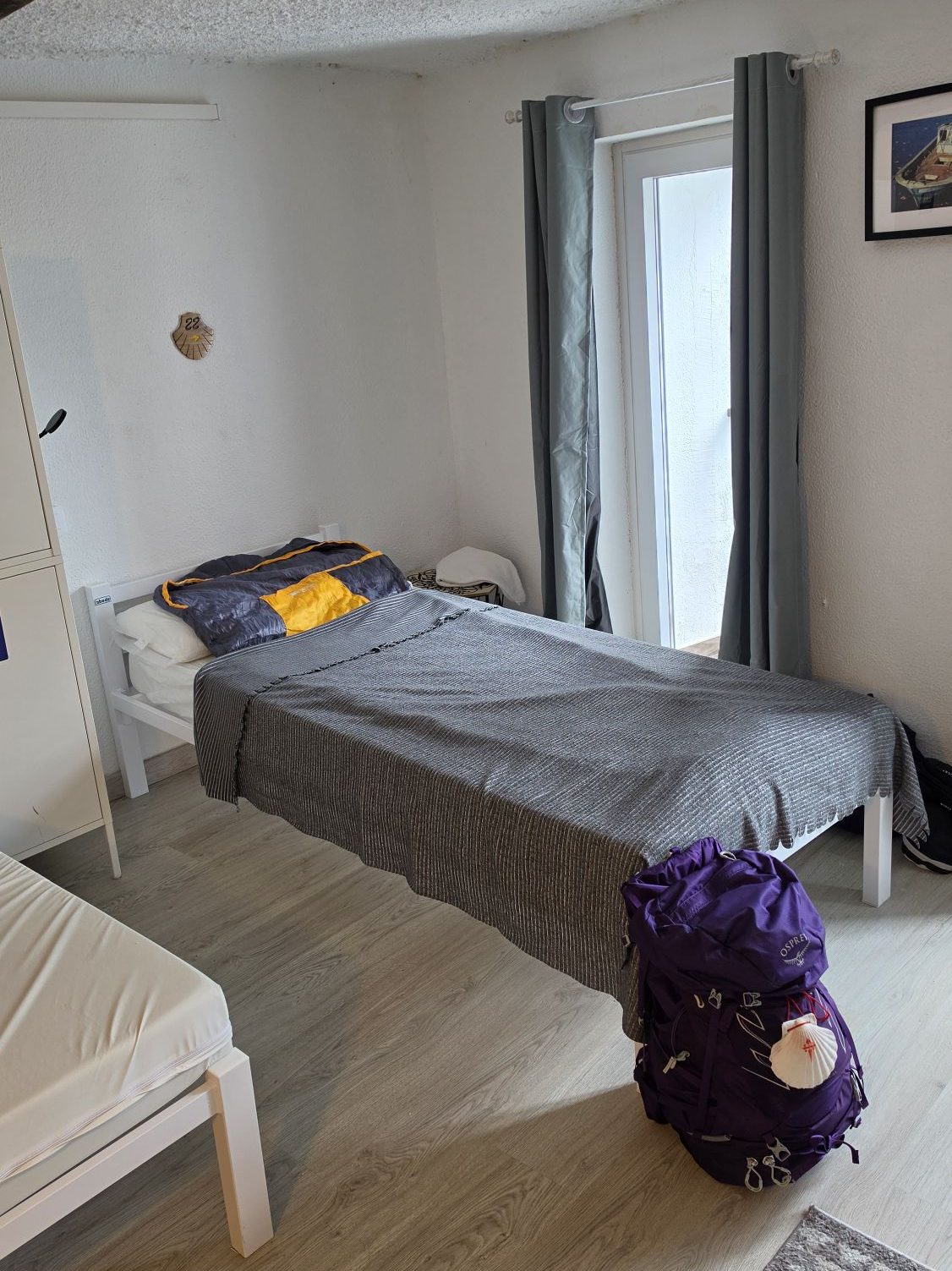
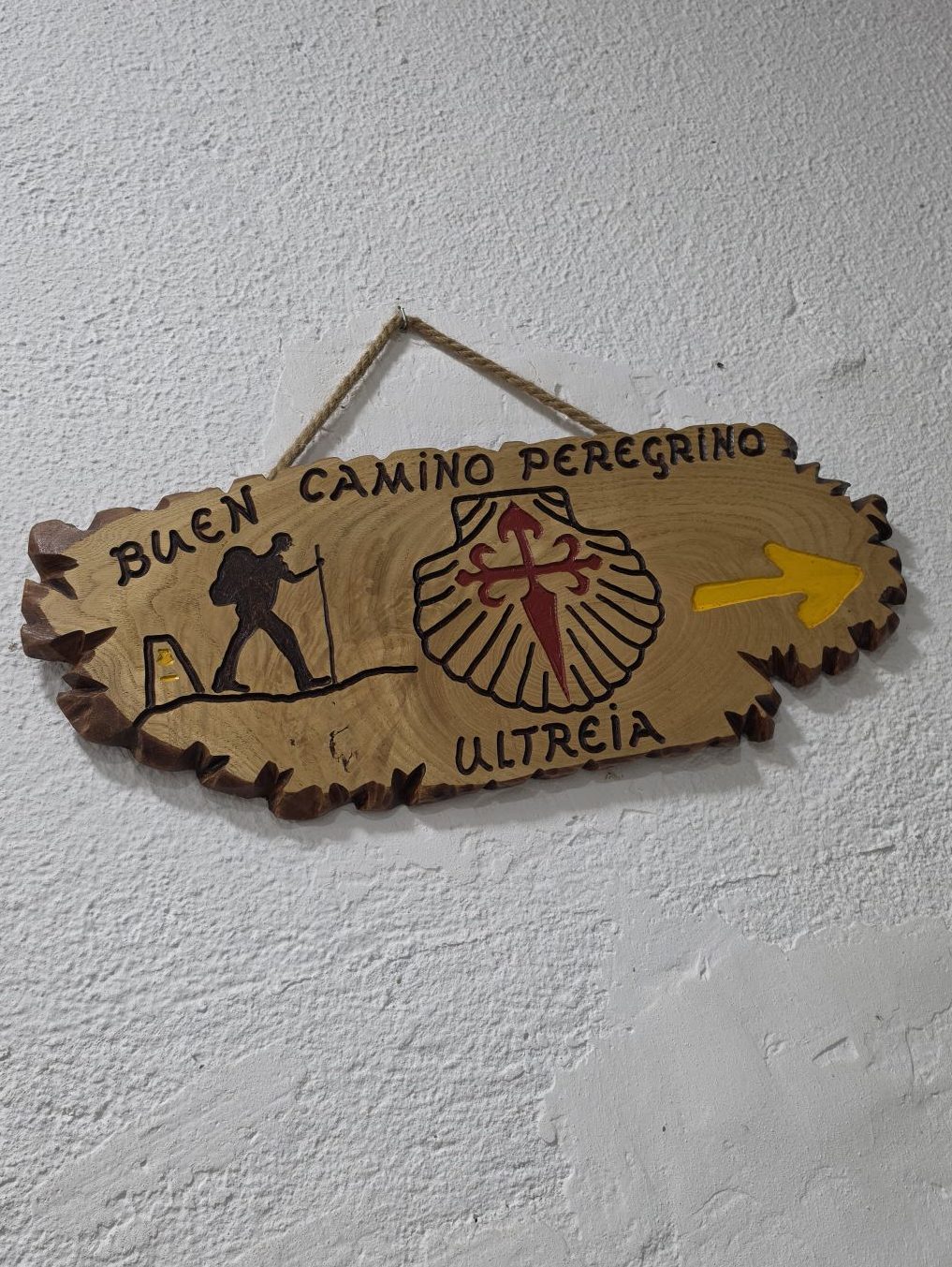
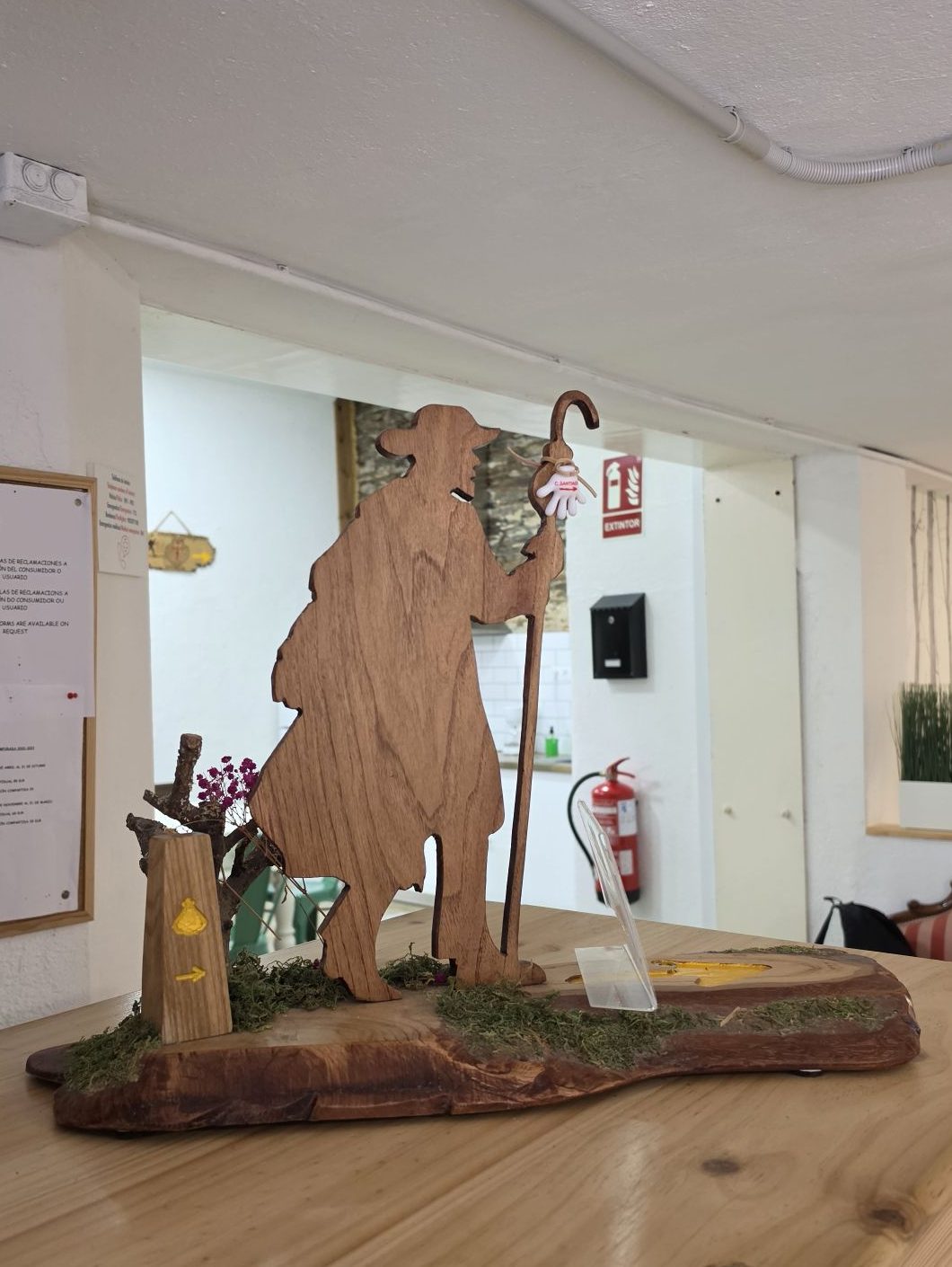
The surprises continued when I was shown around. The albergue had direct access through to a gorgeous little bar and restaurant, with lovely spaces to sit and properly unwind.
I made a mental note of that one immediately and later ended up back there with a cocktail, finally off my feet after 31 kilometres of walking.
One of the other advantages of arriving early was being able to head straight for the shower while everything was still clean, fresh and empty. No queue. No waiting around with your towel. No navigating somebody else’s wet footprints.
Just a shower.
Absolute Camino luxury.
I settled in, and gradually the albergue started filling up.
Then Mikołaj appeared.
Then the other Polish couple.
Then Paulina made it down too.
Somehow, our particular open-plan section of the albergue had turned into a little Slavic corner of Lugo.
And actually, the whole place remained relatively quiet.
After some of the busier albergues we’d stayed in, it made a lovely change. There was no rush for beds, no feeling that everybody was crammed on top of one another.
We could just settle in.
Once I’d showered and changed, I headed back down to the bar I’d spotted during my little tour earlier. I’d arrived so early that there was still plenty of afternoon left, so I ordered myself a cocktail and sat there for a while, perfectly content to do absolutely nothing.
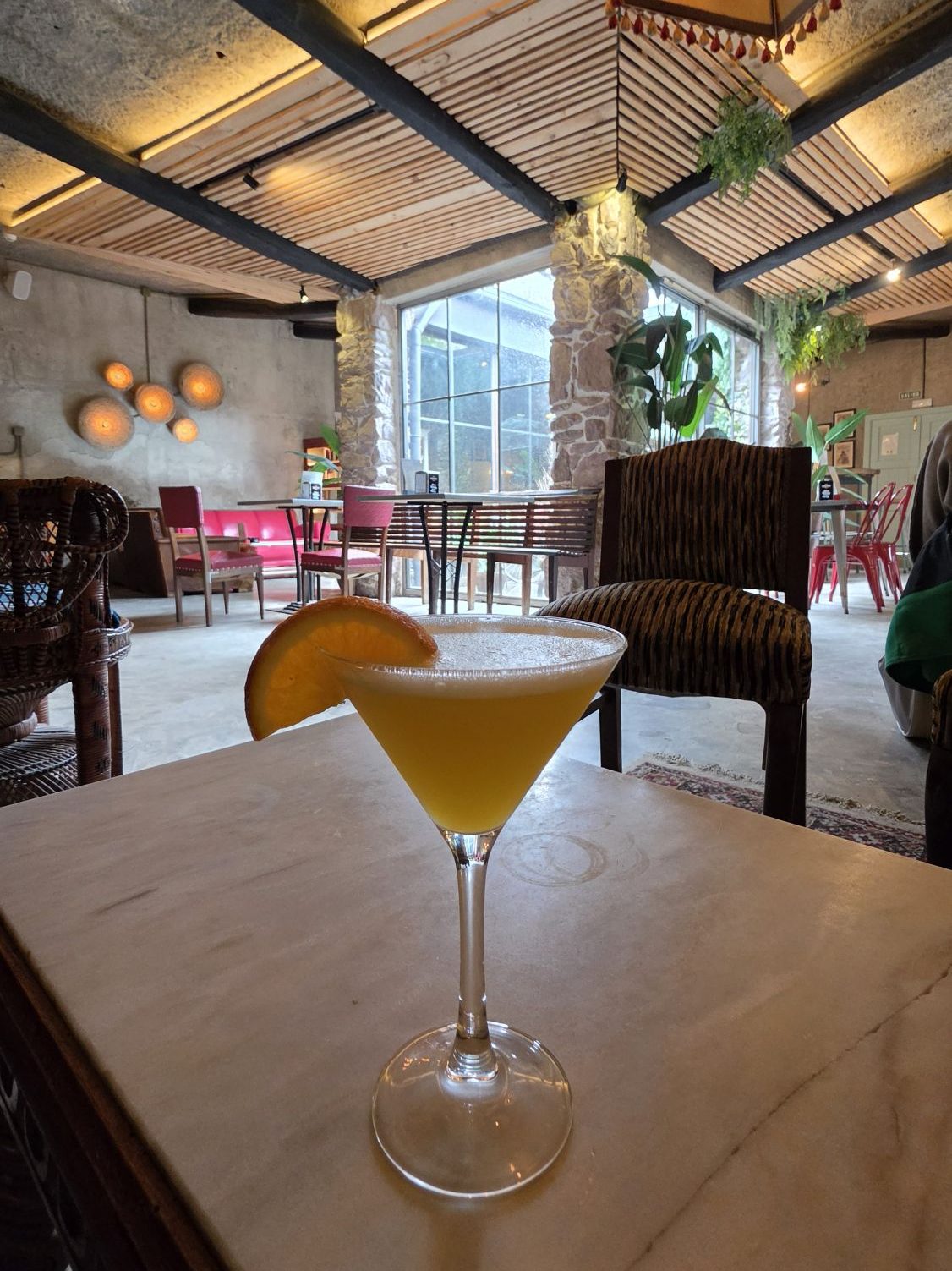
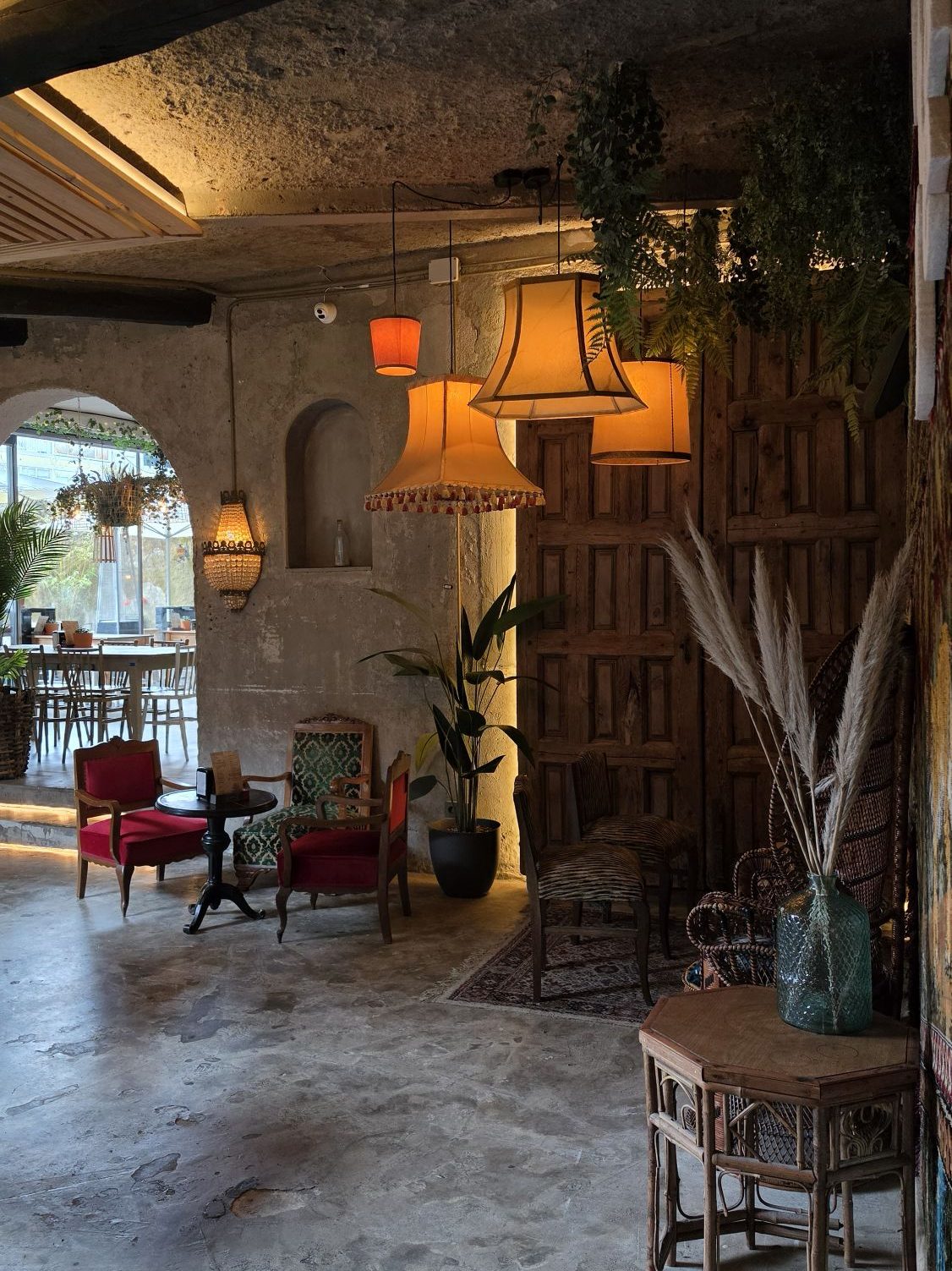
At some point I spotted Pauline arriving and being shown around too. She ended up staying downstairs while I was upstairs, but once again, the Camino was quietly putting familiar faces back in the same place.
Everyone Finds Everyone Again
Later, we all started gravitating towards a little Irish pub down the road.
And this is one of the things I loved about the Camino.
You could spend an entire day alone.
You could walk thirty-one kilometres barely seeing anybody you knew.
And then somehow, by the evening, everyone found everyone again.
At first there were only a few of us.
Then the group started growing.
The Three Musketeers appeared.
Gary arrived with his entourage.
The Texas crew turned up.
The Danish lads came.
Paulina came along.
One by one, familiar faces kept appearing until the solitary morning I’d had felt like it belonged to a completely different day.
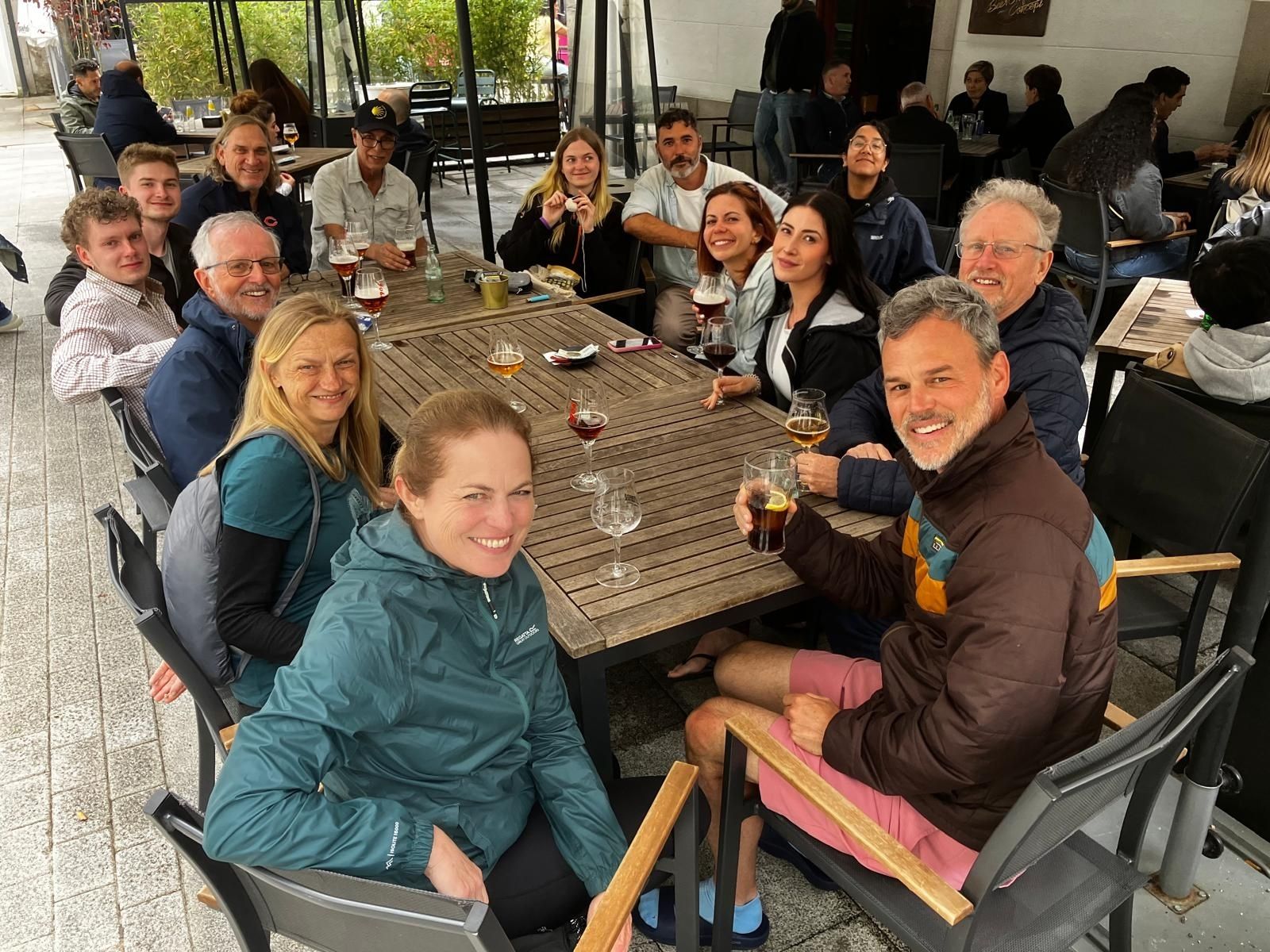
There were drinks, stories from the walk and the usual comparing of how everybody’s day had gone.
I didn’t stay for too many, though.
Lugo is a beautiful old walled city, and I already had a little plan forming for the following morning. You can walk along the top of its Roman walls, and I thought it would be the perfect thing to do before setting off on the next stage.
So, for once, I was going to be sensible.
I’d have an early night.
Wake up early.
Walk the walls while Lugo was still quiet.
And then set off towards the next stop.
A flawless plan.
There was absolutely no way my eye mask, earplugs and apparently exceptional ability to sleep through an alarm were going to interfere with it.
Or so I thought.
Day 10 — Lugo → Ferreira
Distance: 26.55 km
Moving time: 4:48:13
Elevation gain: 556 m
Steps: 31,966
I had plans for my final morning in Lugo.
Very good plans, actually.
Because our albergue was inside the old city walls, I’d decided I was going to wake up extra early, get myself ready and walk a full loop along the top of the Roman walls as the sun came up before heading back onto the Camino.
After all, today’s stage was only around 26 kilometres.
Apparently, after walking 31 kilometres the day before, this was now how my brain measured a relatively easy day.
Unfortunately, my body had other ideas.
I’d been setting my alarms on my watch throughout the Camino rather than on my phone. In a dorm full of sleeping pilgrims, having an alarm vibrating against my wrist felt considerably less antisocial than having my phone announce to the entire albergue that Road Runner had decided it was time to get up.
Except, sometime that morning, I apparently silenced it.
I vaguely remember the classic five more minutes negotiation with myself.
And then I opened my eyes.
For a few seconds, I genuinely had no idea where I was.
Then I noticed the empty beds around me.
Oh my God.
I grabbed my watch, saw the time and immediately went into full panic mode. Everyone had gone. I’d overslept. I was late.
Late for what, exactly, I’m still not entirely sure.
The Camino doesn’t exactly have a departure gate.
Thankfully, I wasn’t quite as abandoned as I’d convinced myself. The Polish gang were downstairs having breakfast, and Paulina, whose bed was next to mine, was still getting herself ready.
She looked over at me as I surfaced in a state of complete confusion.
“You alright?”
“I OVERSLEPT.”
Apparently an extra 45 minutes of sleep was enough to make Road Runner believe the entire Camino had left without her.
I flew around getting dressed and ready and packed up my things. After discovering the previous day just how much difference removing even a little weight from my backpack made, I sent my tote bag ahead again with the luggage-transfer service and kept the backpack with me.
The grand sunrise circuit of Lugo’s walls was clearly no longer happening.
But I wasn’t leaving without seeing them.
So before heading out of the city, I climbed onto the walls and walked a small section instead.
And I’m so glad I did.
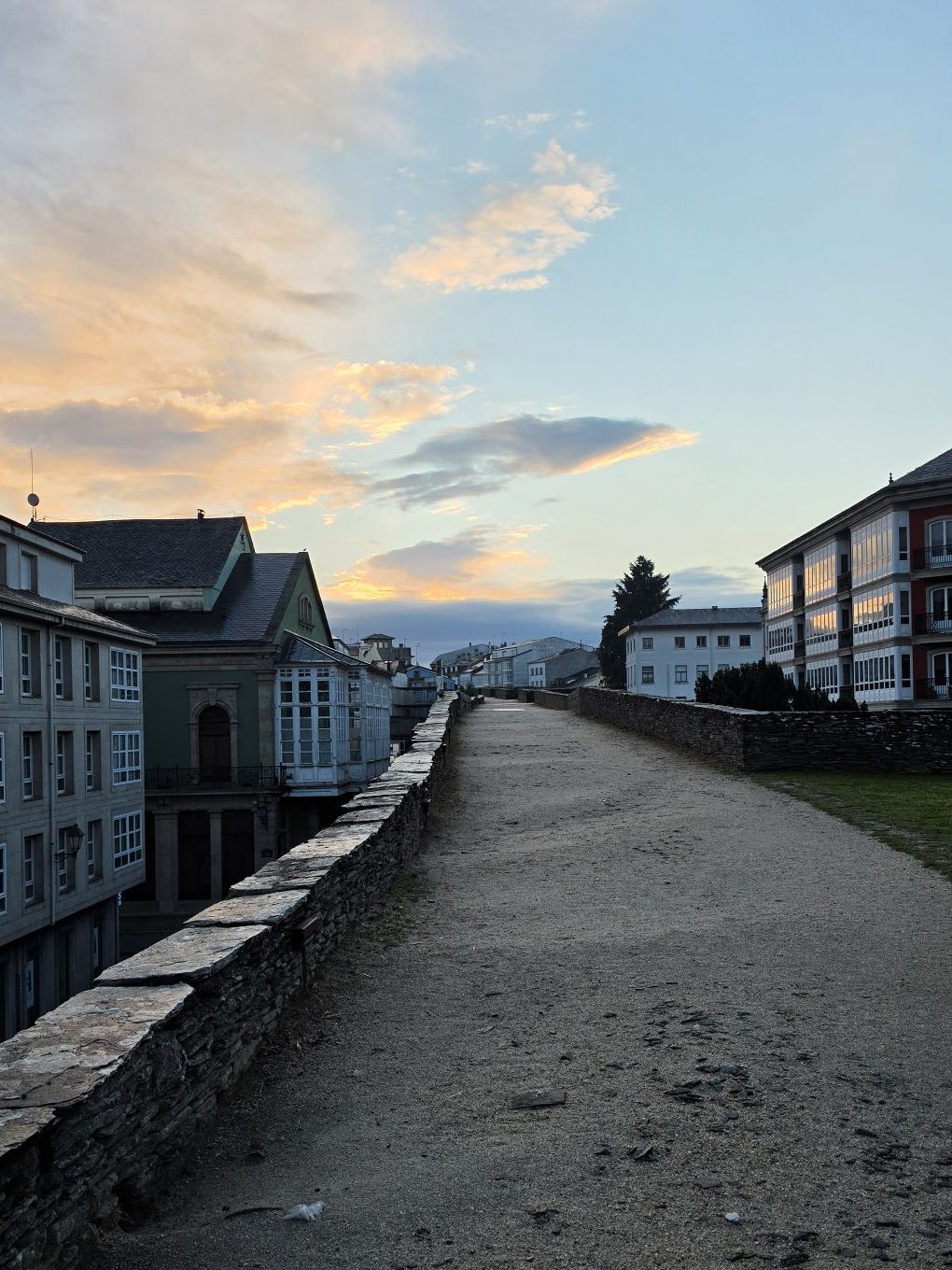
Lugo was still wonderfully quiet. The morning light was beautiful, the streets below were only just beginning to wake up, and for a few minutes I forgot about the completely imaginary schedule I’d convinced myself I was behind on.
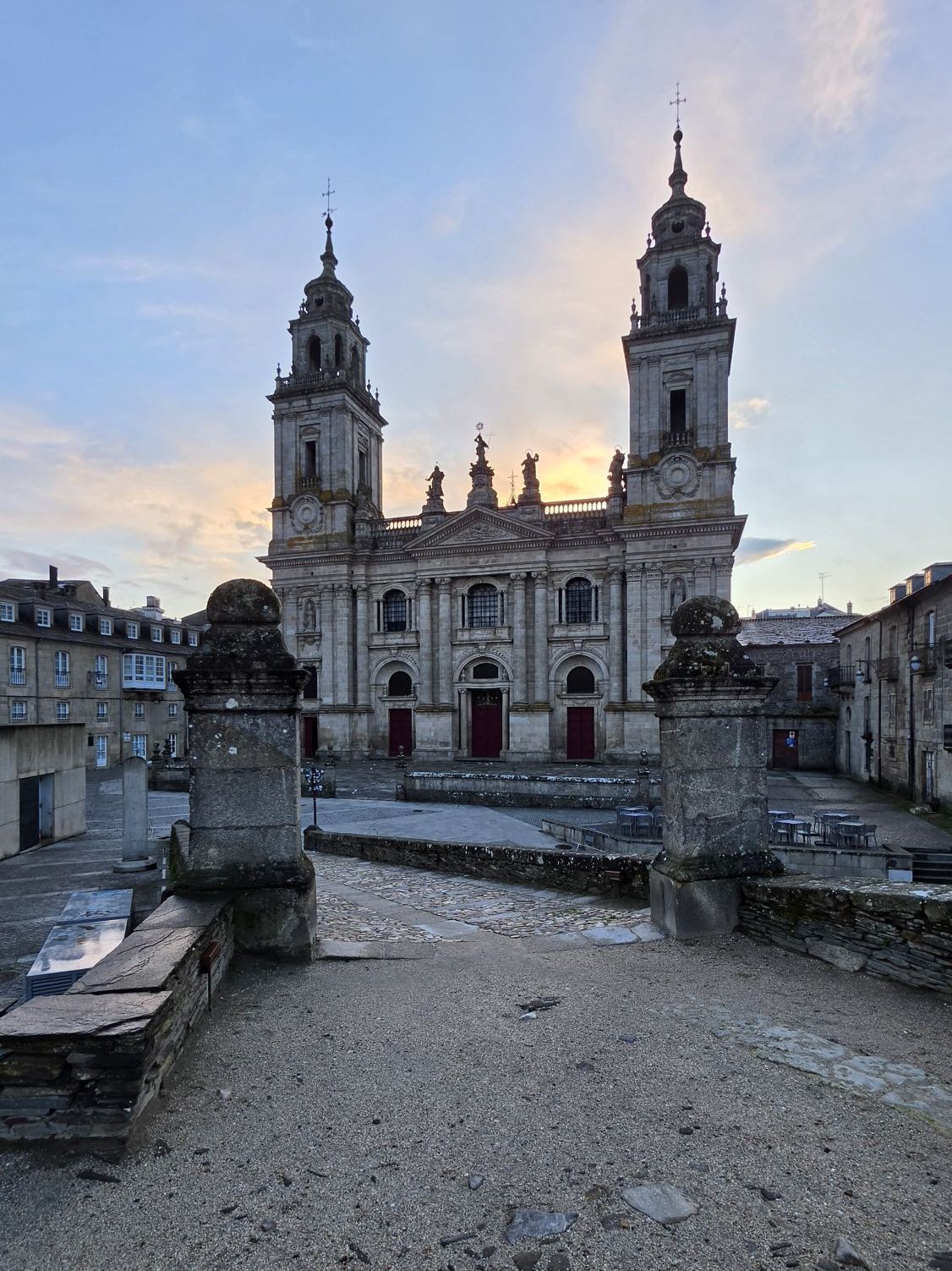
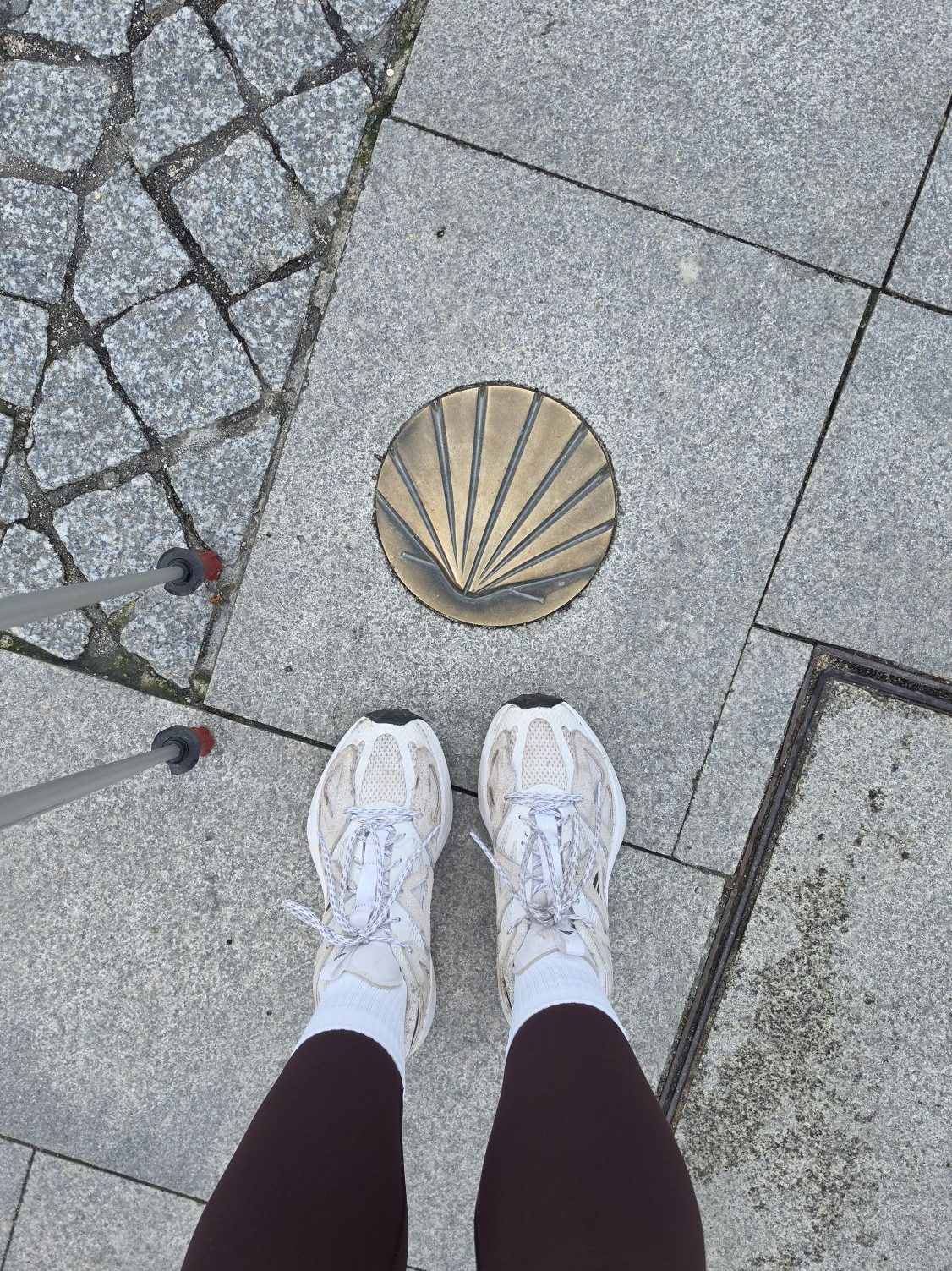
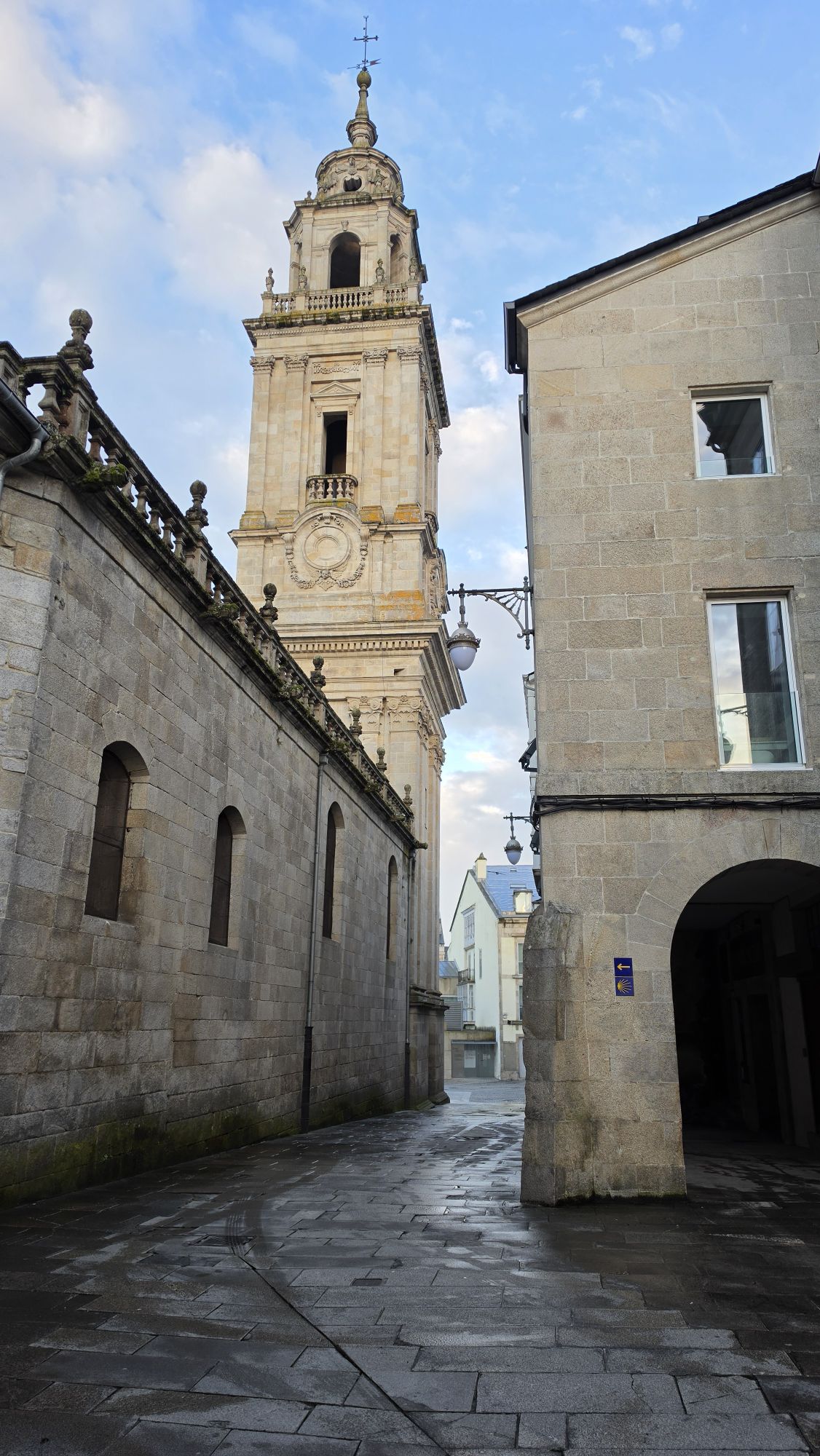
Then it was time to leave Lugo behind and get back onto the Camino.
And because I’d spent the entire morning convinced that everyone else had left hours before me, I assumed I’d be somewhere at the back of the pack for once.
For a little while, I was.
I walked out of Lugo and gradually started passing people who’d clearly been on the trail well before I’d even left the albergue.
Then, further ahead, I spotted a familiar group.
Gary and his entourage.
As I caught up with them, they looked genuinely surprised to see me appearing from behind.
“What are you doing here?!”
I explained that I’d overslept and that, had my original morning gone to plan, I would’ve been somewhere much further ahead by now.
Their response was essentially to move aside.
“Please. Go ahead. You’re going to overtake us anyway.”
And just like that, Road Runner was apparently back where she belonged.
A 45-minute oversleep, a minor existential crisis in the dorm and a detour onto Lugo’s city walls hadn’t made much difference after all.
A Different Kind of Difficult
Compared with some of the stages I’d already walked, the route to Ferreira wasn’t particularly challenging on paper.
There were no enormous mountain climbs. No dramatic Hospitales-style scenery. No cloud-covered peaks.
Instead, there was road.
And then some more road.
And then, just for variety, more road.
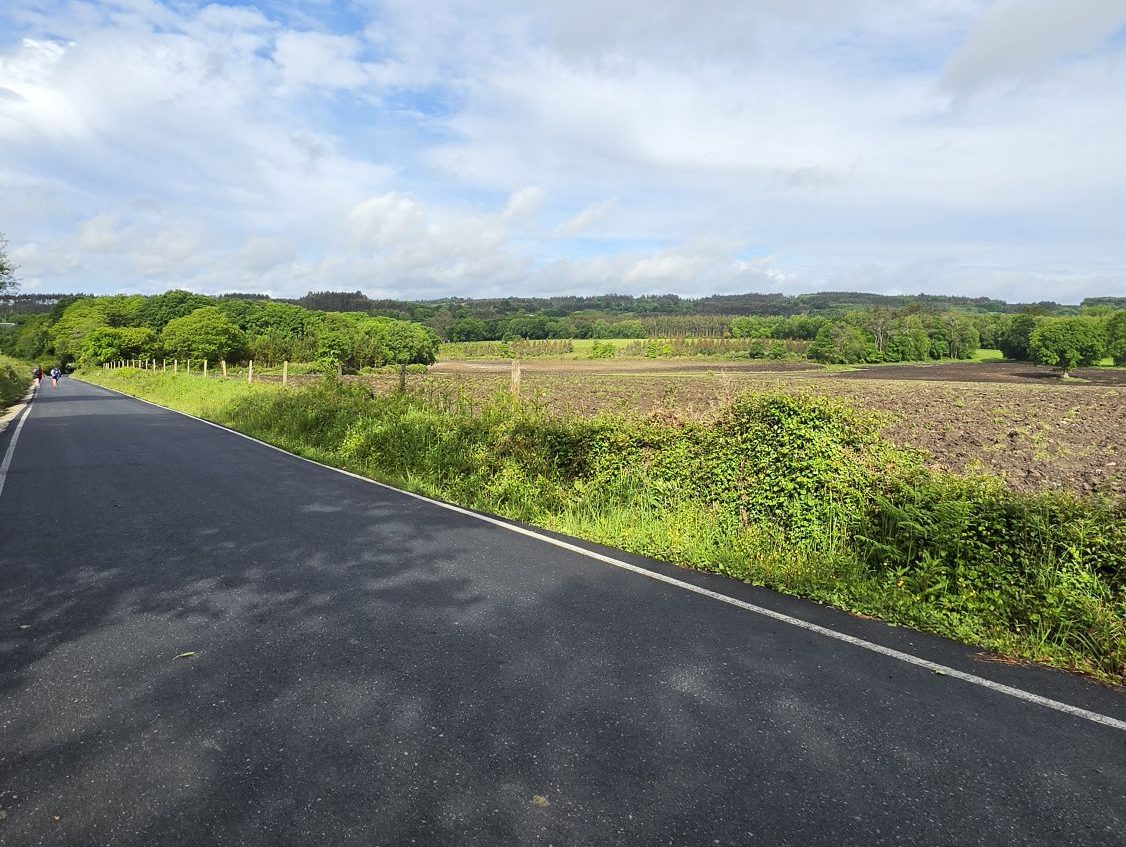
There were beautiful stretches of countryside too, but after the mountains and forests of the first half of the Primitivo, this section felt noticeably different. Long stretches were relatively flat and repetitive, and there weren’t nearly as many cafés or little places to stop as I’d expected.
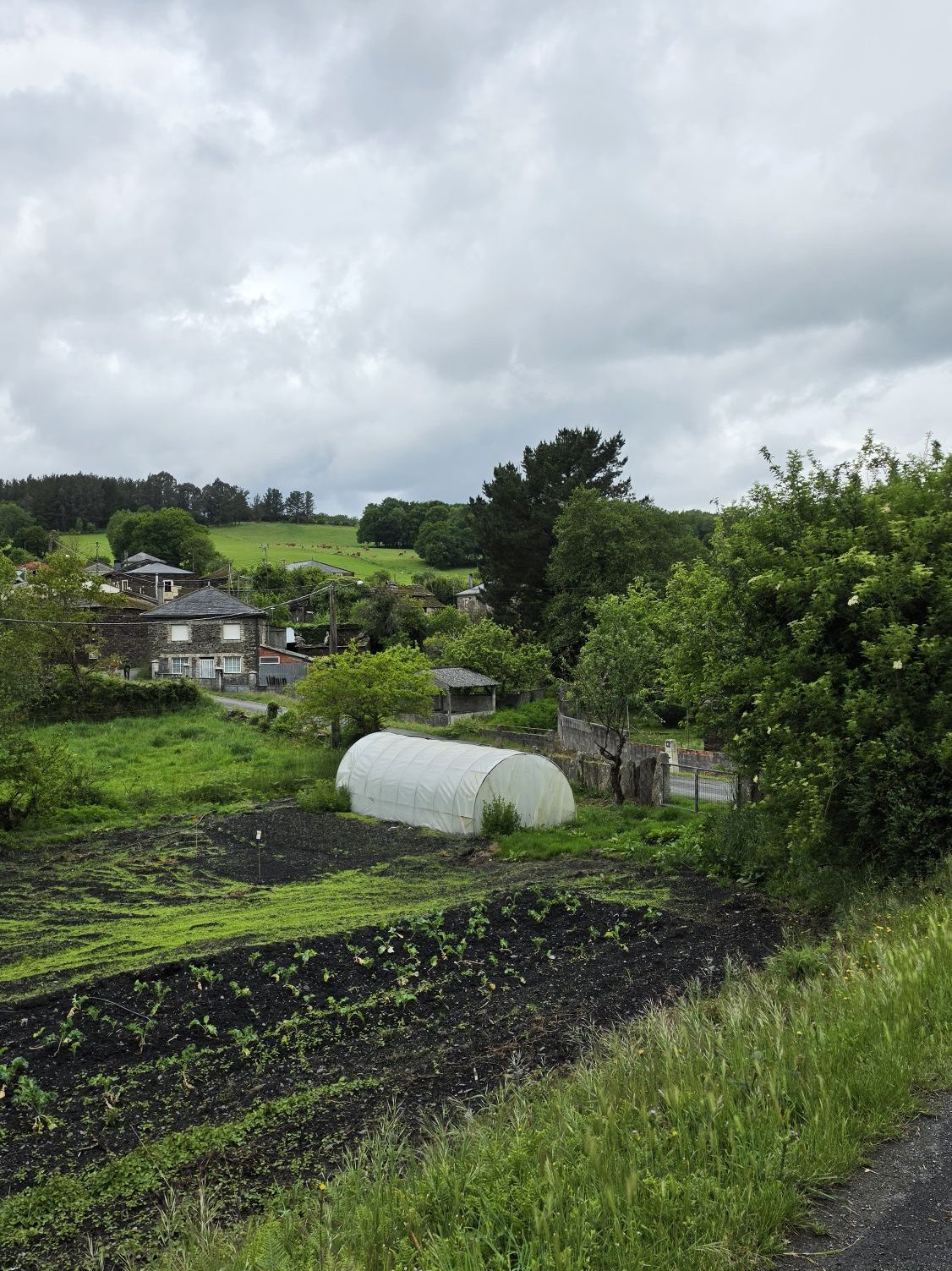
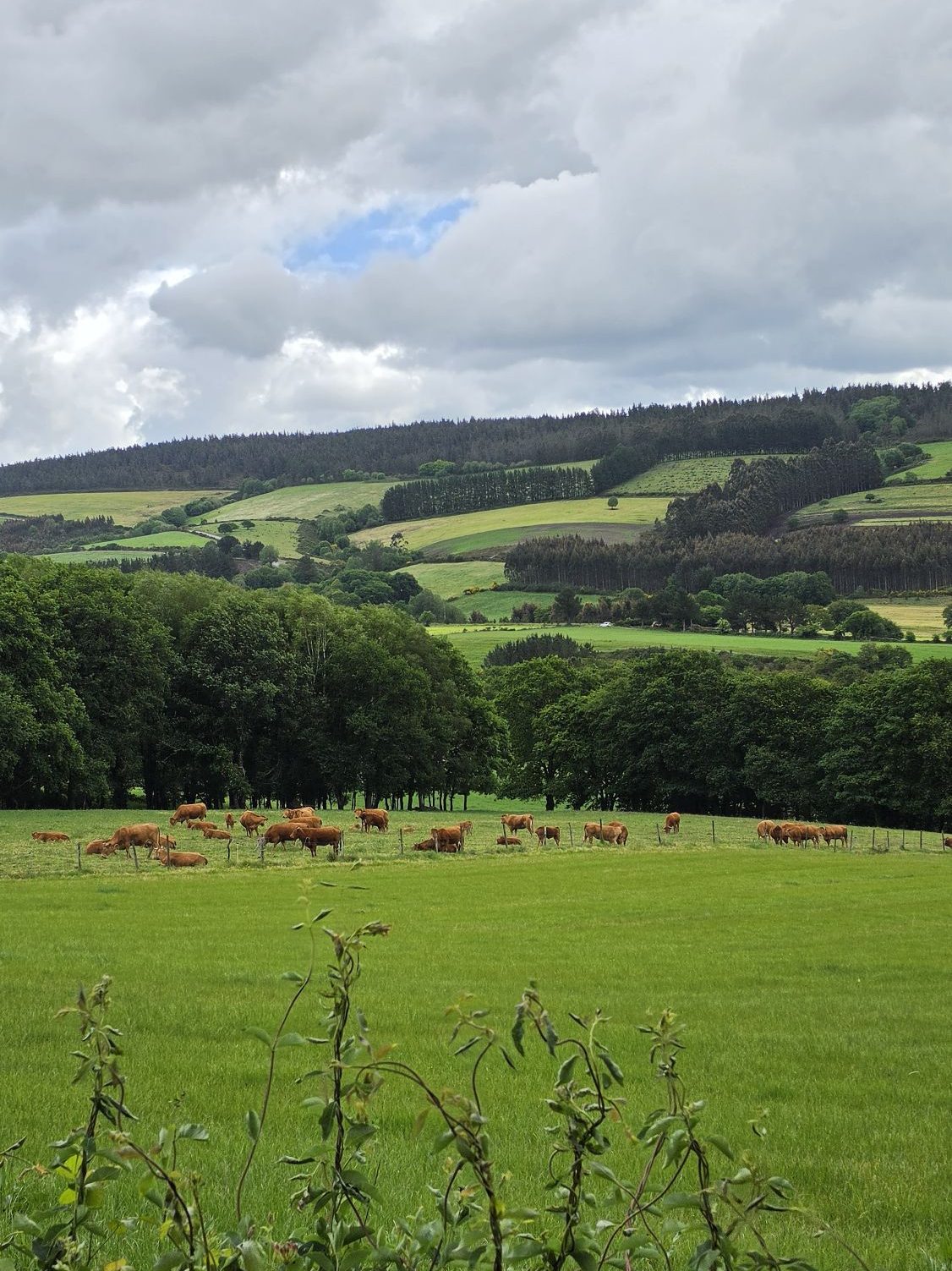
Physically, it should have been easier.
My shin disagreed.
It had already been irritated over the previous days, but I was beginning to realise that walking kilometre after kilometre on hard road wasn’t doing it any favours. At least in the forests and on the trails, there had been some give beneath my feet.
Here, it was just constant impact against hard ground.
Still, there were only 26-ish kilometres between me and Ferreira.
Only.
Look what the Camino had done to me.
The weather couldn’t quite decide what it wanted to do either.
Towards the final few kilometres, the rain arrived.
Poncho on.
Five minutes later: sunshine.
Poncho off.
Then rain again.
Poncho back on.
At this point, getting in and out of that thing was becoming its own Camino skill.
First One In
Eventually, Ferreira appeared.
And despite waking up convinced that I’d somehow fallen catastrophically behind everyone else…
Road Runner was first in.
Of course she was.
The albergue I’d booked had good reviews, and I’d arranged my bed beforehand – I think through WhatsApp – including the most important request of all: bottom bunk, please.
Success.
The room itself wasn’t particularly glamorous and the shower was… questionable.
But it was hot.
After 26.55 kilometres, that was really all I required from it.
Not long after me, the German pilgrim I’d been seeing on and off since O Cádavo arrived too. We’d crossed paths several times by this point, so we finally chatted a little before both disappearing off to perform the standard Camino ritual of showering and becoming vaguely presentable human beings again.
Pauline arrived shortly afterwards, and once we’d changed, we headed to the little bar beside the accommodation.
This turned out to be the perfect place to sit and watch the Camino world arrive.
Pilgrims gradually appeared one by one.
Some were staying with us.
Others waved or called out as they continued further down the trail.
Then the Three Musketeers rolled in.
Then Gary and his gang.
More familiar faces followed.
There was something really lovely about sitting there watching everyone arrive, cheering people on as they passed and seeing the little Camino community we’d somehow built over the previous ten days gradually reassemble itself again.
The Salad
By this point, however, I had a more immediate concern.
I was starving.
Not slightly peckish.
Not I could probably eat something.
Ravenous.
I ordered a salad, and when it arrived it was an absolutely enormous plate.
Everyone looked at it.
“Oh my God, that actually looks really good.”
It did.
And I demolished it.
The entire thing.
I’m fairly certain it was one of the biggest meals I’d eaten in one sitting on the whole Camino, and quite possibly the fastest I’d eaten one too.
Apparently 26 kilometres will do that to you.
And then I discovered something else.
Tinto de verano.
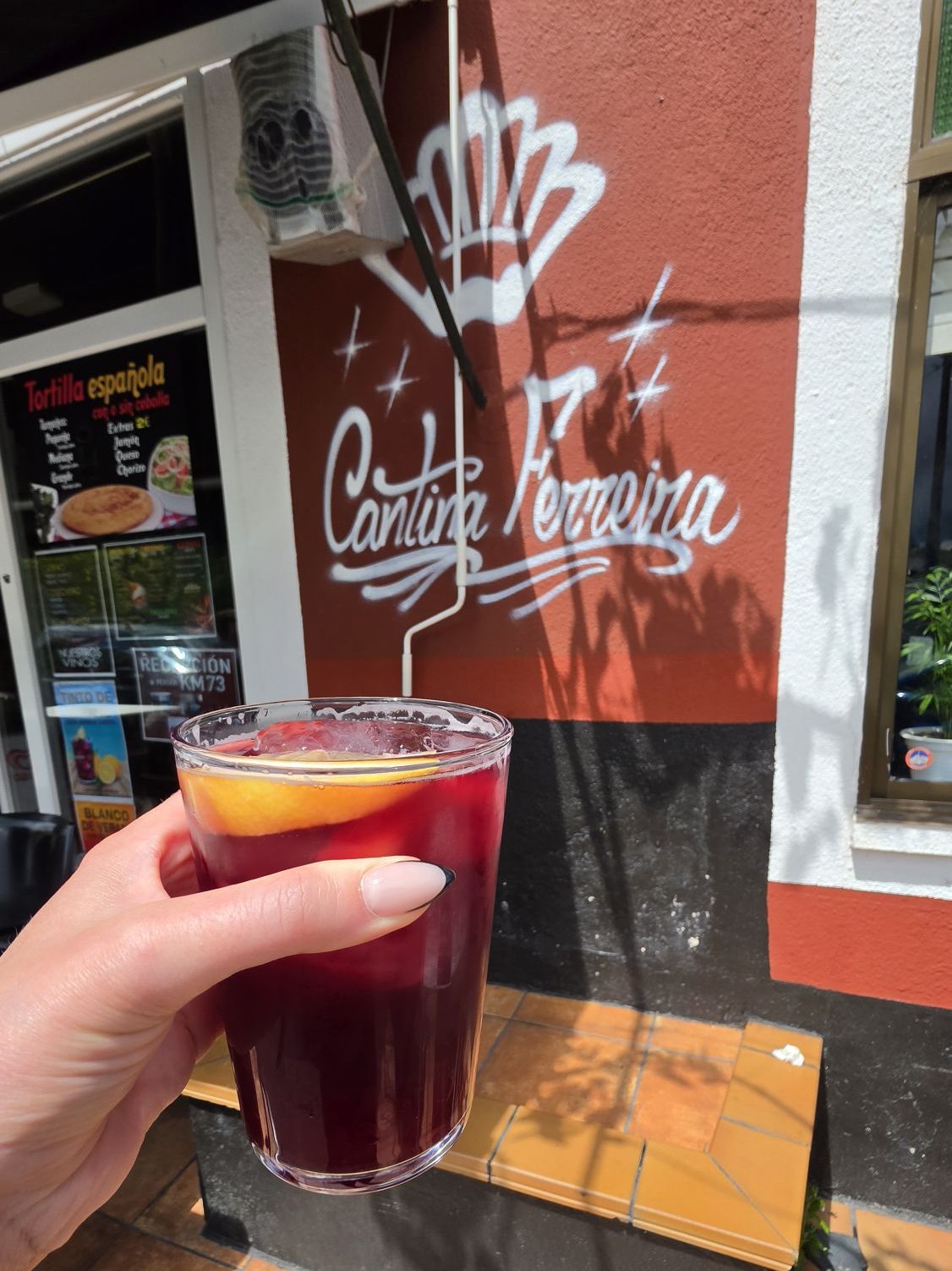
Somehow, despite all my trips to Spain, I’d never really come across it before.
Literally translating as “summer red wine”, tinto de verano is a simple Spanish drink traditionally made with red wine and a fizzy lemonade or gaseosa, usually served over plenty of ice.
Think of it as sangria’s much less complicated cousin.
I ordered one.
And oh my God.
Delicious.
Cold, fizzy, refreshing and exactly what I wanted after a day of walking.
So naturally, I had another.
And from Ferreira onwards, my Camino drink was basically decided.
Forget sangria.
Road Runner had discovered tinto de verano.
A Proper Camino Evening
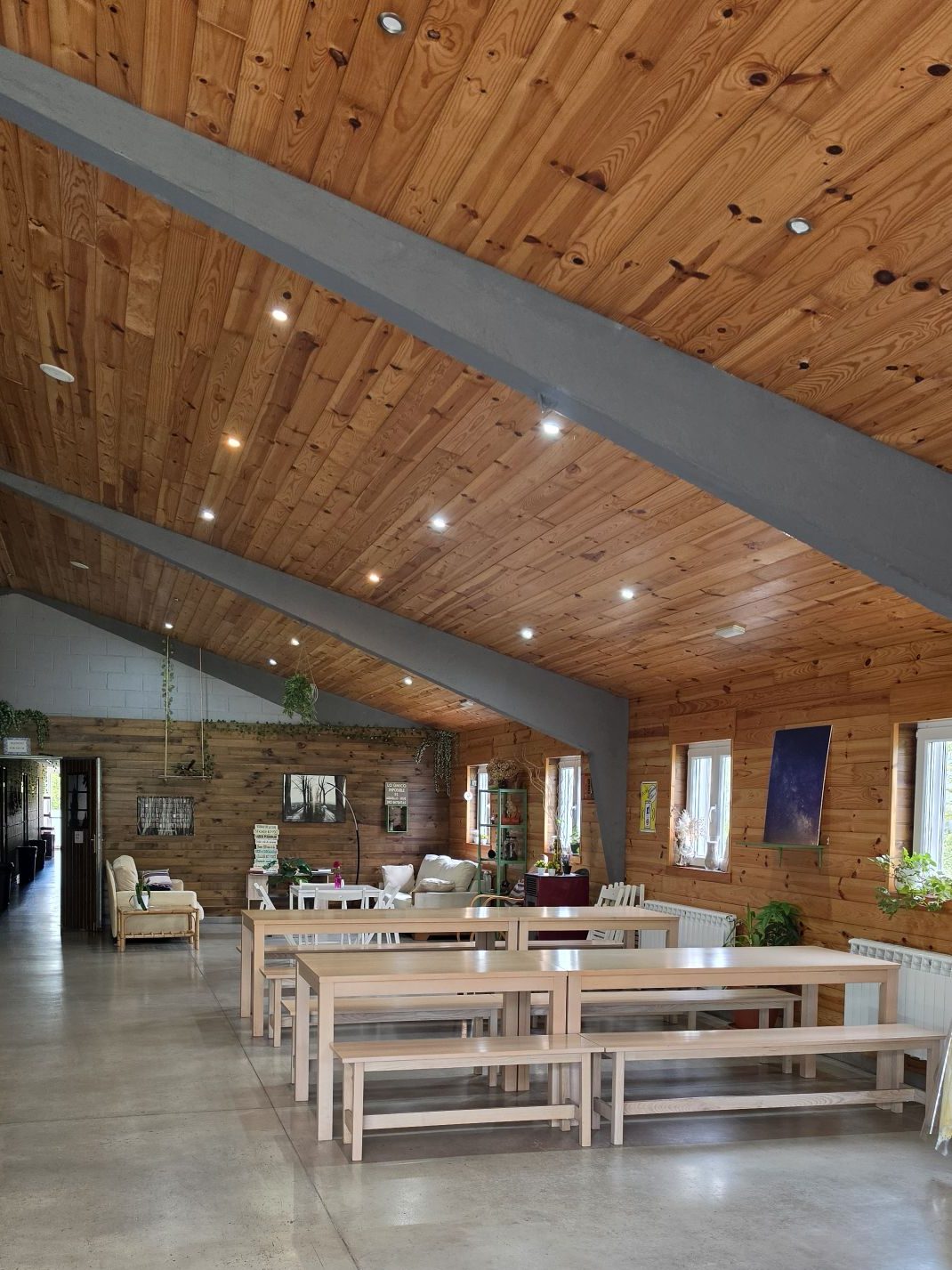
The albergue itself turned out to be much more sociable than I’d initially expected.
Inside was a large communal area with sofas, chairs and benches where everyone could sit together, and there was even a little bar serving wine in proper albergue-branded wine glasses.
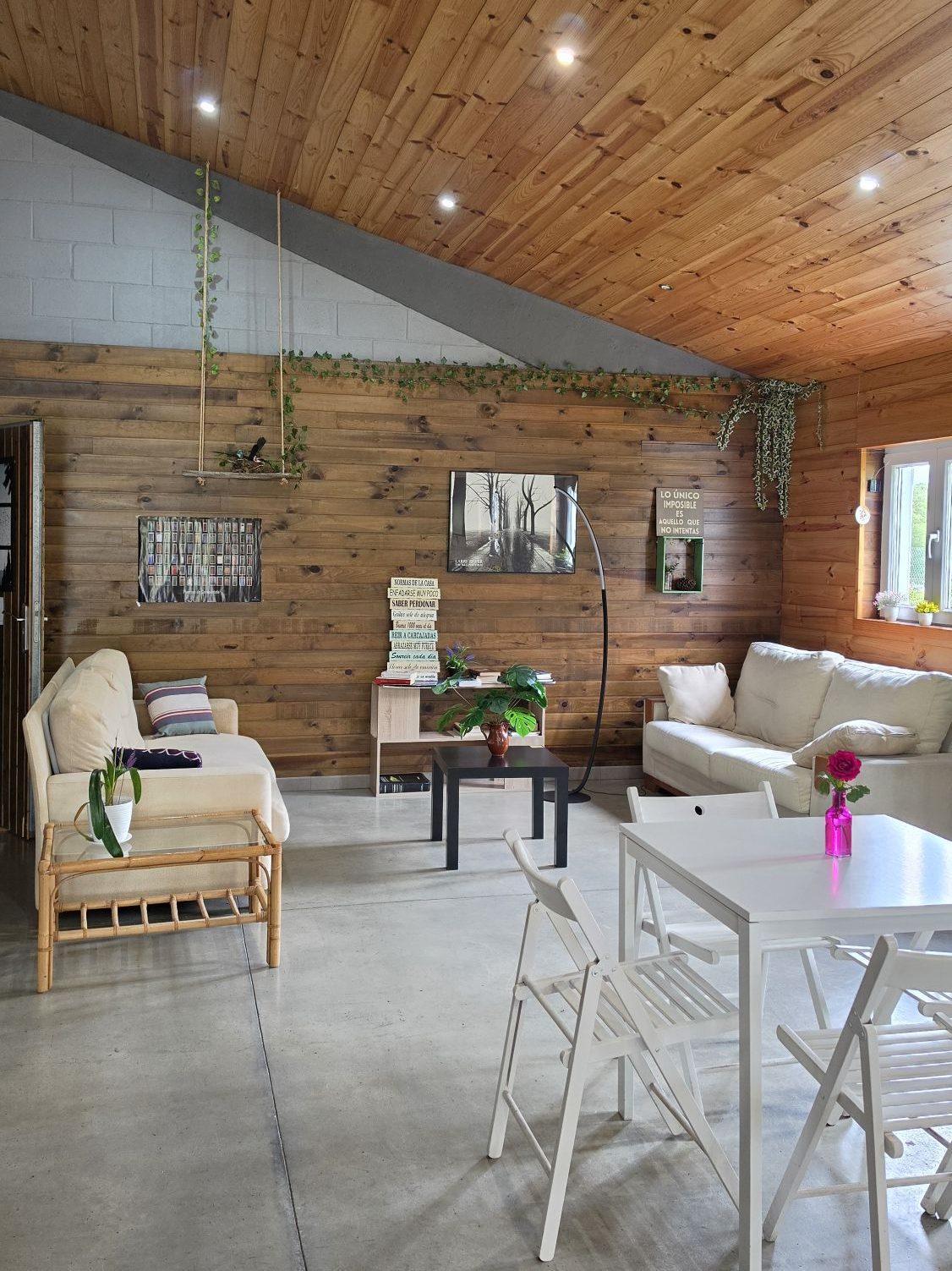
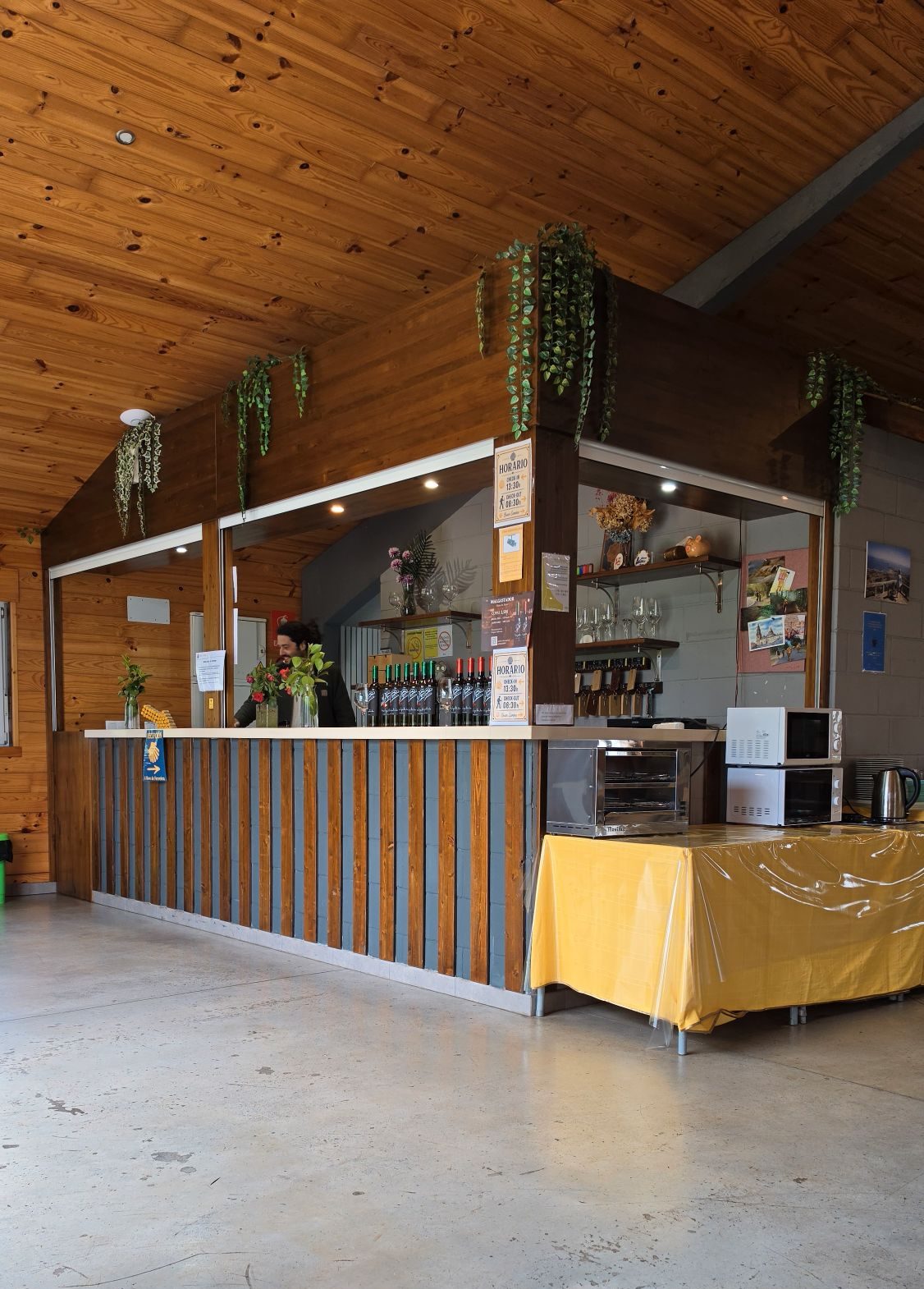
Not plastic cups.
Not random mismatched glasses.
Actual nice wine glasses.
For an exhausted pilgrim who’d spent the previous ten days sleeping in bunk beds, these small luxuries suddenly felt incredibly sophisticated.
As the evening went on, people drifted in and out of the communal area.
I sat with some of the Texas crew for a while. Pauline was there. Cornelius and Ron joined us. Other pilgrims came and went.
There was no grand plan for the evening.
We just sat around drinking wine, talking and catching up on everyone’s day.
And those were becoming some of my favourite Camino moments.
You could spend hours walking completely alone, occasionally spotting familiar pilgrims somewhere ahead or behind you, and then somehow, by evening, everyone would find one another again.
Eventually, tiredness won.
I said goodnight and headed back into the dorm.
There was already someone fast asleep.
A tall guy with dark, slightly curly hair whom I’d noticed several times earlier on the Camino. I’d previously seen him walking with another woman and sometimes around a larger group, but I’d never actually spoken to him.
He’d arrived, barely said anything and seemingly gone straight to bed.
Fair enough.
I understood.
I climbed into my precious bottom bunk, spent a little while catching up on my phone and started getting everything ready for the following morning.
Because tomorrow was going to be different.
I’d deliberately planned my final stages so that I could cover two bigger distances before Santiago, leaving myself with a much shorter walk on my final morning.
I didn’t want my arrival into Santiago to come at the end of another exhausting, hours-long day.
I wanted time to actually experience it.
Which meant tomorrow was going to be a big one.
And after ten days of stubbornly carrying my backpack across northern Spain, I’d finally reached another conclusion too.
It was time for the backpack to go.
Luckily, hidden inside it was one tiny piece of kit that was about to become extremely useful.
But that’s a story for Day 11.
Walk the next stage with me.
Subscribe to Polka-Vita for the next chapter of my Camino Primitivo – plus future Camino stories, routes and reflections from the trail.



Leave a comment