Flying into New York yesterday felt different.
Maybe it was because I knew what day I would be waking up to. Maybe it was because, for the first time in all the years I’ve been flying here, I was arriving just before September 11, and not just any September 11, but the 25th anniversary.
New York is a city I know through work. I’ve flown here more times than I could count. I know the familiar approach into JFK, the long drive into Manhattan, the view of the skyline appearing somewhere between tired conversation on the crew bus and checking how many hours of sleep I might realistically get.
But this time, I couldn’t quite look at it in the same way.
There was a weight to knowing what the following morning represented.
I had already decided that, if I could, I wanted to go to Ground Zero.
Not to turn it into some sort of sightseeing stop. Not because I thought I had anything profound to add to a story that belongs overwhelmingly to the people who lived it.
I just wanted to go.
Quietly.
To pay my respects.
So the next morning, I left the hotel early and headed towards Brooklyn.
My plan was simple: Dumbo first, then walk across Brooklyn Bridge as the city woke up, eventually making my way towards Lower Manhattan and the 9/11 Memorial.
It was one of those New York mornings that makes the city feel almost gentle.
Dumbo was still relatively quiet. The streets hadn’t yet filled properly, and the familiar view of the Manhattan Bridge framed between the buildings looked almost unreal in the morning light.
Then I began walking across Brooklyn Bridge.
There is something so beautiful about approaching Manhattan on foot.
The skyline grows gradually in front of you, the traffic moves beneath you, runners and commuters pass by, and the whole city slowly seems to wake up around you.
On any other day, I probably would have been thinking about the photos, the views, where I wanted to stop for coffee.
But that morning, I knew where I was walking towards.
And the closer I got to Lower Manhattan, the quieter I became.
I hadn’t realised until that morning that the Memorial itself would be closed to the public. On September 11, the space is reserved for the families of those who died. Exactly as, I realised, it should be.
I didn’t try to get closer or find a way around it.
I stayed outside the restricted area.
From where I stood, I was close enough to hear some of the names being read aloud.
And somehow, that felt like enough.
I didn’t need to be standing beside the pools.
I didn’t need the photograph.
I didn’t need to make myself part of something that wasn’t mine.
Because that was probably the thing I felt most strongly that morning: this grief belongs to other people.
To the families who lost husbands, wives, mothers, fathers, brothers, sisters, sons and daughters.
To the people who went to work one morning and never came home.
To those who survived.
To the firefighters, police officers, paramedics and ordinary people who ran towards something everyone else was trying to escape.
And to a city that woke up one morning and changed forever.
Standing nearby and listening to those names being read, I felt very aware of the fact that I was only visiting the edges of somebody else’s loss.
So I stayed for a while.
And then I walked away.
New York continued around me.
People were getting coffee. Taxis were moving through the streets. Shops were opening. Tourists were taking photographs. People were heading to work.
There was something strangely powerful about that too.
Twenty-five years later, the city was still moving.
Not because it had forgotten.
But because life had continued.
Mine did too.
I walked the High Line, stopped at Trader Joe’s on the way back towards the hotel and gradually returned to the normal little details of a layover.
Food.
Steps.
Checking the time.
Thinking about getting ready for work.
Eventually, I headed back to my hotel in Manhattan.
And then came the part of the day that changed how everything felt again.
I showered.
I got ready.
I put my uniform on.
There is something strange about putting on a cabin crew uniform on September 11.
I have been cabin crew for almost ten years now.
Aviation is my normal.
Airports are normal.
Aircraft are normal.
Walking through terminals in uniform, briefing with a crew, boarding hundreds of passengers and crossing the Atlantic at 38,000 feet. All of it has become part of the rhythm of my life.
But on September 11, it is impossible not to remember that the aviation industry I work in today carries the history of that day with it.
Not in some dramatic, everyday way.
Most of the time, we simply go to work.
We complain about delays, drink too much coffee, laugh in galleys, help passengers find space for their bags and count down the hours until landing.
But there are procedures, security measures and ways of operating now that exist because of what happened that morning in 2001.
And on this particular day, I felt that history sitting a little closer.
We travelled back towards JFK as a crew.
By then, I was no longer Patty walking quietly through Lower Manhattan in trainers.
I was back in uniform.
Back at work.
Back inside the world of aviation.
It is a fairly long journey from Manhattan to the airport, and somewhere along the way I found myself doing what most of us do when we have time to kill.
I started scrolling.
And of course, that day, my social media looked different.
There were photographs. Old footage. Stories of people who had been there. Tributes to those who never came home. Moments of remembrance happening all over New York.
And that was when I saw something I hadn’t known had happened earlier that morning.
At 9:11am, Times Square had fallen silent.
For one minute, the usual noise and movement stopped and the screens that normally illuminate one of the busiest places in the world went dark.
I hadn’t witnessed it myself. At around that time, I had been much further downtown, near Ground Zero, listening from a distance as the names were being read.
But watching it afterwards on my phone still hit me.
There was something about seeing Times Square, a place almost defined by light, noise, advertising and constant movement, suddenly dark and still.
And then there was everything else appearing on my screen.
The photographs.
The stories.
The names.
The memories.
Sitting there on the crew bus in my uniform, on my way back to JFK to operate a flight home, I could feel myself getting choked up.
I had spent the morning trying very consciously not to make somebody else’s grief my own. I still felt that way.
But that didn’t mean I couldn’t be moved by it.
And I was.
I think perhaps that was another thing September 11 in New York taught me. Remembrance wasn’t confined to the Memorial.
It was everywhere.
In Lower Manhattan.
On the screens in Times Square.
In the photographs people were sharing.
In the stories being retold.
And now, on a phone screen in the hands of a cabin crew member sitting on a bus back to JFK.
At Terminal 8, there were flowers laid in remembrance.
Another small moment.
Another reminder.
And I found myself thinking again about the crews who went to work that morning twenty-five years ago.
They put on their uniforms too.
They probably checked their bags, met their colleagues, boarded their aircraft and began what they expected to be completely ordinary working days.
They did not know they were stepping into history.
I think that is perhaps what unsettles me most.
Not the scale of it, because the scale is almost impossible to comprehend.
It is the normality before it.
The alarm clock.
The commute.
The coffee.
The uniform.
The briefing.
The boarding.
Ordinary moments before something unimaginable.
I would never compare my experience of September 11 with the people who lost somebody that day.
It is not my grief to claim.
And I would never want to use my job to somehow place myself closer to a tragedy I did not experience.
But working in aviation does make me think about it differently.
Because I understand the ordinary routines surrounding a flight.
I know what it feels like to meet a crew at the start of a duty and know that, for the next several hours, these people become your little temporary family.
I know what it feels like to close an aircraft door and leave the ground behind.
And perhaps that is why, walking through JFK in uniform on the evening of September 11, I felt a kind of quiet gratitude.
For the privilege of going to work.
For the privilege of flying home.
For the privilege of an ordinary flight.
Earlier that morning, I had stood outside the 9/11 Memorial listening to the names of people whose ordinary day never became ordinary again.
Hours later, I was boarding an aircraft to cross the Atlantic.
Same city.
Same date.
Twenty-five years later.
So we closed the doors.
And then we went to work.
I took my position at Door 2 Right and, as we began taxiing towards the runway, I looked out of the window.
And there they were.
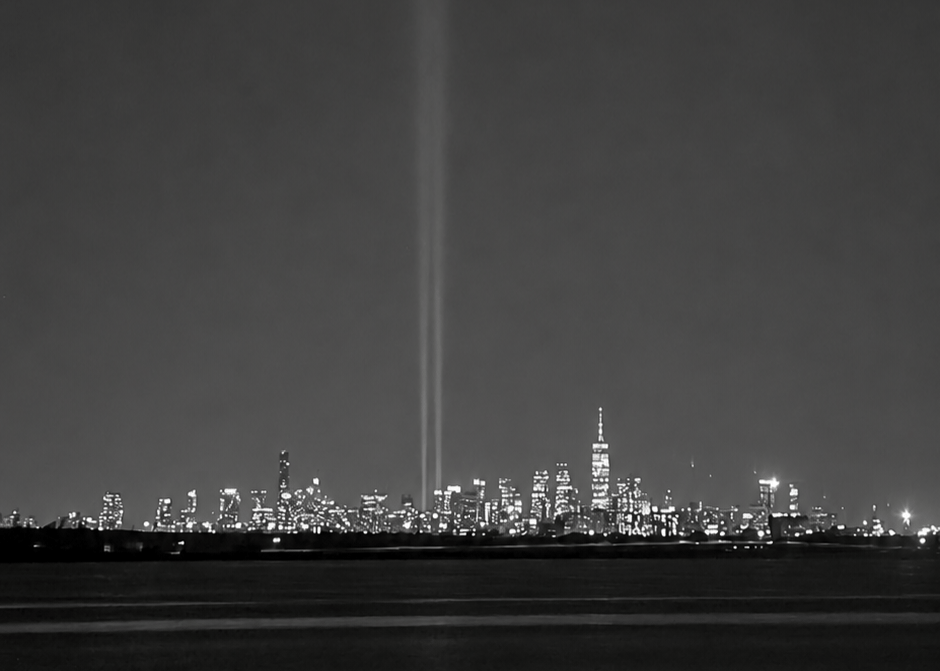
Two beams of light rising into the night sky above New York – The Tribute in Light.
I had known they would be there. I had seen photographs of them before. But seeing them from an aircraft window, on September 11, while sitting on my jumpseat in uniform, was something entirely different.
For a moment, I just looked.
There was something almost impossible about the simplicity of it.
Two columns of light marking the space where two buildings once stood.
That morning, I had walked towards that same part of Manhattan. I had stood outside the Memorial while the names were being read and deliberately kept my distance from a grief that wasn’t mine.
And now, hours later, I was looking back at the city from an aircraft.
In uniform.
From my jumpseat.
On my way home.
As we moved away from New York, the skyline grew smaller, but those two beams seemed to remain visible long after everything around them had begun disappearing into the darkness.
I don’t think I will ever forget that view.
And perhaps more than anything else that happened that day, that was the moment when the two halves of September 11 came together for me.
The morning had been about remembrance.
The evening was about aviation.
And there I was, somewhere between the two.
Once we were airborne, the flight gradually settled into the familiar rhythm I have known for almost a decade.
Seatbelt signs off. Service beginning. Meals going out. Drinks being poured. Call bells ringing. Conversations in the galley. Passengers choosing films, putting headphones on, pulling blankets over themselves and eventually trying to sleep.
All of the completely ordinary things that happen on an overnight flight across the Atlantic.
And after watching those beams disappear behind us, the ordinariness of it felt strangely precious.
I looked around that aircraft and thought about how wonderfully unremarkable it all was.
Hundreds of people travelling from New York to London.
Some going home.
Some going on holiday.
Some travelling for work.
Some probably already thinking about what they needed to do when they landed.
And us, the crew, simply doing our jobs.
There was no fear in the cabin.
No sense that what we were doing was extraordinary.
We were just flying.
And after everything I had seen and thought about that day, I suddenly felt incredibly grateful for that.
Because twenty-five years earlier, other passengers had boarded aircraft in America expecting exactly the same thing.
An ordinary flight.
They had plans for afterwards.
People waiting for them.
Things they were going to do when they landed.
The crew had come to work expecting a normal duty. They had briefed, boarded their passengers, closed their doors and taken off.
Just as we had.
Except they never got the ordinary ending that everybody on our aircraft that night was going to get.
That thought stayed somewhere in the back of my mind throughout the flight.
Not overwhelmingly.
Not dramatically.
Life and work carried on around it.
There were still trays to clear, passengers to look after, things to prepare and probably several cups of tea to make.
There were still little conversations and laughs with my crew.
There was still that peculiar middle-of-the-night feeling you get on a transatlantic flight when most of the cabin is dark and quiet and, for a few hours, the aircraft feels like its own tiny world suspended somewhere above the ocean.
And eventually, as it always does, night began turning into morning.
We prepared the cabin for arrival.
Window blinds started opening. People woke up. Blankets were folded away. Seat backs came upright. Bags disappeared back underneath seats.
And somewhere ahead of us was home.
When we finally landed at Heathrow, I was tired.
It had been a long day. Longer emotionally, perhaps, than I had expected it to be.
But we had landed.
We had arrived safely.
Our passengers collected their things and walked off the aircraft to whatever was waiting for them on the other side of those doors.
And eventually, so did I.
I went home.
Such a small sentence.
Such an ordinary thing.
But after spending September 11 thinking about thousands of people who never had the chance to do exactly that, it didn’t feel quite so ordinary anymore.
I had walked through New York that morning as the city remembered.
I had listened from a distance as names were read aloud.
I had put my uniform on.
I had gone to work.
I had sat on my jumpseat and watched two beams of light rise above Manhattan.
I had crossed the Atlantic.
And then I got to go home.
Maybe that is what I will remember most about spending September 11 in New York.
Not that I stood at Ground Zero.
Because I didn’t.
Not that I somehow understood what that day was like.
Because I couldn’t.
But that for one day, I was made intensely aware of something we are lucky enough to take for granted most of the time.
An ordinary day.
An ordinary flight.
And the privilege of making it home.
Twenty-five years later, New York remembered.
Aviation remembered.
And life carried on.
As it should.
Without forgetting.



 Polka-Vita
Leave a comment